Every election is a challenge in India. In a vibrant democracy, with lots of freedom allowed to express oneself, and with unique reservation, religion, language and other pertinent issues, you can expect every election to be colourful.
2018 Karnataka election is likely to happen in May 2018. Let's examine what are the potential issues on which this election would be decided. There are mainly two parties fighting 2018 election - Congress and BJP. But JDS has sufficient base in southern Karnataka, hoping to become a King Maker with 40 to 60 seats out of 224 in the assembly. As of the final week of 2017, things look quite murky with no clear winner capable of crossing the magical 113 mark. These are not in any order, as any issue can flare up as high-priority one on any given day!
1) Kannada Pride: Usually language is not a big issue in Karnataka elections. Mining, Corruption, inter-state issues, Caste etc. are the big ones. But expect a lot of language pride (Kannada aasmite) to show up in 2018.
Advantage? Congress and JDS.
Disadvantage? BJP.
Where would it mostly affect? Urban and Semi-urban areas. Maybe up to 15 MLA seats.
Why? Congress has worked for a whole year mobilizing various groups on social media and on the streets to show that Kannada is not given preference in may areas. NEET exams, new state flag, Metro train Hindi boards, central government offices not helping in Kannada, banks missing Kannada, railways not helping in Kannada and a whole lot. "Hindi Imposition" which is a Tamil Nadu trademark, slowly inching into Karnataka politics this time. The funny part is that most of this "imposition" was done between 1969 (nationalization of 14 banks) and 2010 (by which most regional languages had disappeared in Railways) by various Congress governments. But now it is easy to blame everything on Narendra Modi. So the game is on!
BJP has not defended against this attack till now. The goal of JDS and Congress is to show that BJP is a Hindi imposing "North Indian party". And they are working very hard to paint that impression.
2) Interstate Water Sharing Issues: Kaveri is a permanent issue in Karnataka politics, but for a change, 2018 might not see any anti Tamil Nadu sentiment in campaigns. Because unlike 2016 which was a horrible year of drought, 2017 has seen excess rainfall. Also Jayalalithaa is no more, who was a permanent fixture in Supreme Court cases, dragging Karnataka into conflict year after year. Tamil Nadu is busy with internal broken party politics, and there is enough water in both states. The much talked about Mekedatu dam on Kaveri did not even take off. No one is talking about that failure of Siddaramaiah. Krishna water sharing has been smooth from Karnataka's side. Bhima is not an issue now. So the attention would be with the tiny state of Goa, which is hardly the size of one of the neighbouring districts of Karnataka. Mahadayi, which originates in Karnataka, flows west into Goa becoming Mandovi. There is a long pending drinking water project near Hubballi city which needs about 5% of Mahadayi water in a year. But as usual with everything in India, unnecessary complication has come in. The issue is very hot now. Something that could have been sorted out on a table in 30 minutes, 30 years ago, has become a Tribunal, Court, Politics and Emotional issue.
Advantage? JDS.
Disadvantage? BJP and Congress.
Where would it mostly affect? North West Karnataka. Up to 35 MLA seats.
Why? For nearly 4 years, Siddaramaiah government did nothing except writing letters, giving speeches, and some delegation meeting. Now close to election, Congress is putting pressure on Modi to solve the issue directly. Because courts and tribunals would take forever, and it is easy to put the ball in Modi's court. On BJP side, Yeddyurappa met with Parrikar and Shah, worked some consolation out, but quick acting Congress has thwarted the entire thing. The goal is to put BJP in the guilty position saying that both central government and Goa government are BJP's, and they are not helping Karnataka. The funny part here is that Congress in Goa is playing the exact opposite card, trying to unseat Parrikar by painting him as anti Goa! In fact, the whole issue became a big problem after Sonia Gandhi gave a divisive speech in Goa ten years ago. Maharashtra also has a small part to play here. JDS is trying hard to saying both "national" parties have failed and it should be given a chance, while it failed to solve it when in power 12 years ago. Also JDS is also a "national" party technically :)
While politicians are doing all politicking, farmers are very angry - they are neither getting drinking water, nor the long term irrigation water. Two years, ago the anger was against Siddaramaiah for the brutal lathi charge his government ordered in Naragunda area. But now, it seems like the villain would be Yeddyurappa if something concrete does not come up.
3) Farmer Suicide: 2014 through 2017 have been terrible years for Karnataka farmers. Suicides have occurred on three major river basins - Kaveri, Tungabhadra and Krishna.
Easily, more farmers have committed suicide during Siddaramaiah's Congress regime, than many prior governments combined.. maybe a few decades worth of governments combined.

Advantage? BJP and JDS.
Disadvantage? Congress.
Where would it mostly affect? Throughout rural Karnataka. Maybe 40 to 80 seats.
Why? 3515 farmer suicides is not a joke. And this number might not even be the total number, as many are talking of much higher number. Families have been destroyed. Farmers are very angry at Congress government for giving pittance as compensation. One farmer Vittal Arabhavi had consumed poison and committed suicide right across from Suvarna Soudha in Belagavi, when assembly was happening. All the ads that Siddaramaiah gives about how he has helped farmers, do not stand a chance if BJP and JDS inform voters that poor governance was one of the biggest reasons for such large scale farmer suicides. But for now, this is not a very hot issue, as other emotional issues have been raked up. It is up to BJP to delicately handle this issue and help farmers. Also, BJP has a long list of good schemes of central government like crop soil card, crop insurance, MUDRA loan etc, to inform the farming families. Loan waiver is an ever green topic. Siddaramaiah doing a small waiver on cooperative loans did not yield any dividend, and Congress will keep pressing for a bigger waiver from the central government on nationalized banks. Kumaraswamy of JDS has already played loan waiver card. Whoever wins farmers' vote in large pockets, will easily win 2018 election. But right now, the situation of Karnataka farmers is in pretty bad condition.
4) Karnataka government in massive debt as a result of freebie governance: This again is a result of copying Tamil Nadu politics by Congress. Everyone knows that from Amma canteen, to free rice to other freebie politics, was a trademark of TN politics.
This month news items showed massive debt numbers since Congress came to power in 2013.
News link: Debt: more and more...
2013: when Congress came into power- Rs.1.12 lakh crores
2013-14 end -Rs. 1.36 lakh crores
2014-15 end- Rs. 1.55 lakh crores
2015-16 end- Rs. 1.80 lakh crores
2016-17 end- Rs. 2.05 lakh crores
2017- 18 end (expected)- Rs. 2.42 lakh crores
We are looking at Rs.38,000 debt over every head in Karnataka by the time this government finishes five year period.
Advantage? BJP and JDS.
Disadvantage? Congress.
Where would it mostly affect? Urban Karnataka. Maybe 25 to 30 seats.
Why? This is a tricky topic. Though Siddaramaiah has made more debt than all other CMs since 1947 (then Mysore) combined, he is still within the magical 25% limit of GSDP. So he can always claim that there is nothing wrong as he is using it for tonnes of socialist freebie projects like Anna Bhagya, Ksheera Bhagya, Shadi Bhagya etc. Congress also keeps showing that they have managed better investment into Karnataka than even Gujarat, without going into details of how much of that is central government's investment. Also, it is not clear from the ads as to what percentage is actually finished implementation generating jobs.
BJP on the other hand, has to push hard to show how this has harmed the state's economy and in spite of so much loan, the state has not seen any major irrigation or infrastructure benefit. Bengaluru in particular can understand this, with 28 seats at stake here. But for now, BJP has not been successful in driving home this point, and most people are not talking about this major issue. Lack of visible job creation is an important matter, which BJP has not capitalized so far.
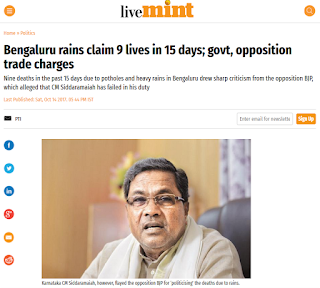
5) Bengaluru Issues: Since Bengaluru has over 10% of the seats in Karnataka assembly, it is vital for all the three contenders. Dismal state of Bengaluru in traffic, rain/flood/encroachment, lack of infrastructure, overflowing foam in lakes, has hurt the brand image of Bengaluru across the country and in many cities in the world. Garbage issue is still not solved. People literally got washed out in poorly finished drains. Traffic has been a joke across the city.
 Advantage? BJP.
Disadvantage? Congress and JDS.
Where would it mostly affect? Bengaluru - Up to 20 seats.
Why? Bengaluru elected BJP as the single largest party in 2015 BBMP corporation election. But Congress managed to snatch the Mayor seat from BJP by allying with JDS and managing overall majority using MLAs, MPs and MLCs. So naturally people are not happy with the setup. Bengalureans voted for BJP to form the local government, not Congress. So it is a big advantage in favour of BJP now, if they play the cards properly. Large scale infrastructure issues have dissuaded more companies to come into Bengaluru off late, with stiff competition from Hyderabad, NCR and other areas in India. Encroachment removal drive affected lot of poor people, while the rich and movie stars were spared. There is a lot of simmering anger among the Bengaluru city dwellers, who totally account for well over 60% of Karnataka's state revenues. But in return for so much tool, tax and cost they pay, they are getting pittance in return. Nothing worth mentioning has happened to show the world that the last 4 years were great for Bengaluru.
Congress on the other hand keeps blaming earlier BJP local government for loans. Congress is betting that populist schemes like Indira canteen (copy of Amma canteen of TN) will fetch lower middle class votes. Siddaramaiah is also very prompt in putting ads for any good news about Bengaluru, anywhere in the world - like the most dynamic city title, without thinking for a minute as to what was his government's contribution!
JDS can't say much as it is an opportunistic party which allies with Congress in Bengaluru, and with BJP in Mysuru!
6) Youth belonging to Hindu organizations murdered across the state: This is a big election issue as of now. Till now, these political murders were usually limited to Kerala in news. But more than 20 RSS, BJP and Hindu org people have been murdered since Siddaramaiah came to power. That has angered a lot of people. This month, a book written by famous Kannada Editor Hariprakash Konemane came into news.
Advantage? BJP.
Disadvantage? Congress and JDS.
Where would it mostly affect? Uttara Kannada, Dakshina Kannada, Kodagu, Bengaluru and more. Up to 40 seats.
Why? Almost every year, there have been multiple murders since Siddaramaiah came to power. Political murders were there before also, but why BJP supporters are angry this time is - there is no visible action against the extremist ideologies that are targeting Hindu activists. To make things worse, Congress government had dropped 175+ cases against the notorious Muslim organization PFI when BJP was calling for PFI's ban. And since then, the deaths have been hot news every few months, with blames going squarely to Siddaramaiah's head. On the other hand Congress has been vociferous in blaming BJP and its leaders for provocation and disrupting "communal harmony". The usual targets are Pratap Simha, Anant Kumar Hegde and Shobha Karndlaje. JDS can't talk much on this, as it has also lost its cadre to murders, but since it needs to be in power in Bengaluru with Congress, has not made much noise. BJP squarely blames Ramanatha Rai, Siddaramaiah, Roshan Baig and other Congress leaders for provocations. Overall, there is a lot of fear factor among Hindu activists, which might affect a large section of voting depending upon how politicians use the fear. Siddaramaiah is seen as someone squarely siding away from Hindu organizations with his open calls to fight "communal forces" meaning RSS and BJP in his language. Cow slaughter is one of the most discussed issues since 2013 when Siddaramaiah repealed an earlier bill of BJP for stricter slaughter controls.
In fact, Karnataka being declared as the most communally sensitive state in 2017, is not going to help Rahul Gandhi when he campaigns here in 2018. Overall, law and order, women's safety, and related issues will pop up too.
7) Leadership Quality: Who is the strongest leader in Karnataka right now, is a big question. For Congress, Siddaramaiah is undoubtedly a tall mass leader now. With a weak High Command and Congress wiped out of most of India, Siddaramaiah's hands are stronger than ever. He also has not much competition from within Congress now as Mallikarjuna Kharge, DK Shiva Kumar, Janardhana Poojary, Parameshwara are not in a position to challenge him. He has projected himself as a mass leader for AHINDA (A = Minority, Hin = Backward Castes and Da = Dalit in Kannada) groups. Thought Yeddyurappa's KJP helped a lot in splitting BJP votes in 2013, a big credit is for Siddaramaiah's caste calculations. He is definitely a formidable force in Karnataka politics in 2018. Even though Congress has lost some stalwarts like SM Krishna, Srinivasa Prasad and Vishwanath, not much damage has happened on the ground for voter base. Even some serious charges against Siddaramaiah like expensive watch, de-notification, Lokayukta damage, ACB cases, nothing has dented his position as the top leader of Congress. Siddaramaiah also has a strong support among "Buddhi Jeevis" who have been cultivated with careful events and awards over the years.
Advantage? None have distinct lead in the CM's race.
Disadvantage? Not much choice for any party.
Where would it mostly affect? Everywhere. Hard to quantify.
BS Yeddyurappa is a top leader for BJP now, though not as powerful as he was in 2008 elections. He is nearing 75 years, so there is a lot of question mark on whether he would complete a term if elected as CM. But undoubtedly he is the only BJP mass leader now who can draw crowds in all 30 districts of Karnataka. His strength includes tremendous connection with voters across castes. He can attract diverse caste groups and commands respect of rural voters in many districts. But his biggest disadvantage is his corruption cases from 2010 and 2011 period. Though he is not convicted in any court of law, his brief jailing (for failing to get bail) has dented his reputation. Siddaramaiah talks about this all the time, and BJP is defenceless here. Though BJP has a RSS man as governor now, he is nowhere as lethal as Bharadwaj was when UPA was in power at the center. There are lots of young and emerging leaders for BJP like CT Ravi, Shobha Karandlaje, Anant Kumar Hegde, Pratap Simha to name a few. But none are close to CM's chair at present like BSY. He is BJP's biggest strength, yet the biggest weakness also now.
HD Kumaraswamy of JDS is a very clever leader. Deve Gowda has trained his son in political maneuvering very well. His strengths include mobilization of Gowda (Vokkaliga) votes in 4 to 5 districts of south Karnataka. That loyal voter base can easily get him 20% of the assembly seats. He is also clever to latch on to politically beneficial issues like CM's watch, Mahadayi, Minorities etc. But his weakness is the pan state reach. Also he is tainted due to previous mining and other cases against him. JDS is not having much base beyond old Mysuru region, and also his health is not in top shape as he underwent heart surgery recently. Overall a sure shot king maker, but a long shot king if JDS manages 70+ seats.
8) Caste Equations: Two major caste issues for 2018 elections would be Lingayat as separate religion, and inner-reservation within Scheduled Castes (SC).
For decades, the issue of Lingayats being separate dharma or religion outside of Hinduism had surfaced. But for 2018 elections, concrete plans have been put in place. Rallies have happened across the state and Congress party's ministers like MB Patil and Vinay Kulkarni have actively mobilized lakhs of people for separating Lingayats from Hinduism.

Advantage? Congress.
Disadvantage? BJP.
Where would it mostly affect? Mostly in North Karnataka. Up to 50 MLA seats.
For decades, there was a debate as to whether Lingayats were different from Veerashaivas. There was also a debate on whether one or both of them are separate from Hindu Dharma. But this time Congress has openly taken sides and trying its level best to get Lingayats a petition for minority status. This has created massive rift within Lingayat - Veerashaiva community with 100s of Jagad Gurus from each side in verbal battle with the other section. It has not been pleasant to watch! Moreover, Lingayat - Veerashaiva has been together the biggest voting bloc for BJP, helping in more than 60 MLA seats during 2008 elections. This time, BJP has played a wait and watch position, which only time will tell if it helps BJP or not. Congress has already started smiling that it has split the biggest voting bloc of BJP. JDS has not much to gain or lose when it comes to this community as it has not much votes here.
The second caste equation is that of Dalits or Scheduled Castes. In Karnataka, there are mainly three groups of Scheduled Castes - The Right Hand, The Left Hand and the Misc Dalits. You can read here about the 1960 Dalit organizations in Karnataka, and 100+ caste divisions within the SC group.
The potential big issue for 2018 election is the "Ola Meesalati" or Inner Reservation issue.
Advantage? BJP
Disadvantage? Congress
Where would it mostly affect? In nearly 50 reserved constituencies.
Since conducting caste census a few years ago, Congress government has not released the data. But is has access, so it is carefully working to avoid the inner reservation issue from flaring up. Initially Dalit CM issue had popped up, but Siddaramaiah cleverly pushed that to inconsequence. But off late, the non-Right-hand Dalits have been vocal in securing fixed percentage of reservation within the SC quota, which would be a huge blow to Congress. In 2018 elections, the right hand SC might support Congress, while the left hand SC might go with BJP. If the reservation quotas within Dalit quota are altered, there would be huge implications on voting pattern. JDS is not a big factor in Dalit politics at present, but you can never rule out anything.
Muslim and Christian votes would be mostly be with Congress or JDS, depending upon who plays better card. BJP has been kept away with constant rhetoric from Congress side on this matter. Tippu Jayanti was one such massive project to consolidate Muslim votes into Congress for 2018. To counter this, BJP might get one or two saffron clad candidates too!
9) The Modi factor: This is a pan-India factor, which will certainly have effect in Karnataka. But to what extent is a big question mark.
In mid 2013, BJP had lost a state election and was in terrible shape due to KJP and BRSC splits. Morale was very low. At that time, it was Karnataka that gave massive hope to Narendra Modi in south India by volunteers forming Namo Brigade. It was so successful, that literally lakhs of youth poured into work for Modi as PM. And they succeeded in shaping the opinion in favour of Modi in no time.
Advantage? BJP
Disadvantage? Congress, JDS
Where would it mostly affect? In nearly 50 constituencies.
A state that gave the highest MPs for BJP from south India, the state which is considered as a gateway for south India for BJP, has lots of potential for Modi. But the key is.. will people vote in state election seeing Modi's promises, work and face?
BJP leaders think very positively. Because a lot happens with just Modi's name on the ground. Even after 3.5 years, Modi remains a very popular PM for Kannadigas. But Congress thinks otherwise. It is painting Modi and Shah combo as outsiders, and just talk without action guys. Siddaramaiah has been particularly harsh on Modi in his speeches. JDS is not that vocal, as clever Deve Gowda is not letting people know which side the wind is blowing. Overall, if BJP manages to rekindle the NaMo Brigade energy across the state, Modi factor alone can change the results in 25 to 50 seats. Devolution of taxes, MUDRA yojana, farmer policies, Explaining Digital India in India's silicon valley, GST, Bank Accounts and 100+ other schemes can be carefully explained by 17 Lok Sabha MPs and 4 Rajya Sabha MPs of BJP here. But can they beat the perception battle launched by Congress against Modi using demonetization, "15 lakhs" and tons of other local factors?
Can Rahul Gandhi be a factor? Doubtful considering the current scene. But after the sudden temple run in Gujarat, nothing can be ruled out.
10) Vote Division: This is a part of every election. Congress is trying hard to divide the Lingayat vote bank of BJP. BJP is trying hard to dip into Dalit vote bank of Congress. A number of small parties are coming into fray with Kannada film star Upendra's party being the notable one. If they manage to get even 10% votes in 20 constituencies, that would directly affect BJP as most supporters of Upendra's party would be urbanites. There were news reports of Congress getting tacit support from SDPI on Muslim side.
Advantage? Everyone
Disadvantage? Everyone
Where would it mostly affect? In nearly 100 constituencies.
But BJP will be trying hard to use Triple Talaq to divide Congress party's trusted vote bank here. A couple of years ago, Hasana had a movement of Muslim ladies led by Banu Mushtaq, a Kannada writer, to enter a mosque for prayers. Both BJP and Congress are trying to dent into JDS' core vote bank of Vokkaligas/Gowdas. BJP has already tried to dent into Siddaramaiah's Kuruba vote base, using Rayanna Brigade. Congress is on a spree to give land to various caste groups to secure as much votes as possible. SC/ST would be the most crucial bloc along with Lingayat considering the various uncertainty right now.
But one thing is certain - Unlike Hardik Patel and others in Gujarat, there is not much of an unknown person's entry into election right now. All are time tested faces.
In fact, Development is not a key issue at all as of today! Unfortunately so. Caste will be a dominant issue. There might be more issues, but let me stop here for now.
Your comments, corrections and additional pointers are most welcome! Take this blog post as an attempt to get more people to talk of issues, and get a clear idea, rather than campaigning for any party or against a party. In short, take it easy :)
2018 Karnataka election is likely to happen in May 2018. Let's examine what are the potential issues on which this election would be decided. There are mainly two parties fighting 2018 election - Congress and BJP. But JDS has sufficient base in southern Karnataka, hoping to become a King Maker with 40 to 60 seats out of 224 in the assembly. As of the final week of 2017, things look quite murky with no clear winner capable of crossing the magical 113 mark. These are not in any order, as any issue can flare up as high-priority one on any given day!
1) Kannada Pride: Usually language is not a big issue in Karnataka elections. Mining, Corruption, inter-state issues, Caste etc. are the big ones. But expect a lot of language pride (Kannada aasmite) to show up in 2018.
 |
| Image: IndiaTimes.com |
Disadvantage? BJP.
Where would it mostly affect? Urban and Semi-urban areas. Maybe up to 15 MLA seats.
Why? Congress has worked for a whole year mobilizing various groups on social media and on the streets to show that Kannada is not given preference in may areas. NEET exams, new state flag, Metro train Hindi boards, central government offices not helping in Kannada, banks missing Kannada, railways not helping in Kannada and a whole lot. "Hindi Imposition" which is a Tamil Nadu trademark, slowly inching into Karnataka politics this time. The funny part is that most of this "imposition" was done between 1969 (nationalization of 14 banks) and 2010 (by which most regional languages had disappeared in Railways) by various Congress governments. But now it is easy to blame everything on Narendra Modi. So the game is on!
BJP has not defended against this attack till now. The goal of JDS and Congress is to show that BJP is a Hindi imposing "North Indian party". And they are working very hard to paint that impression.
2) Interstate Water Sharing Issues: Kaveri is a permanent issue in Karnataka politics, but for a change, 2018 might not see any anti Tamil Nadu sentiment in campaigns. Because unlike 2016 which was a horrible year of drought, 2017 has seen excess rainfall. Also Jayalalithaa is no more, who was a permanent fixture in Supreme Court cases, dragging Karnataka into conflict year after year. Tamil Nadu is busy with internal broken party politics, and there is enough water in both states. The much talked about Mekedatu dam on Kaveri did not even take off. No one is talking about that failure of Siddaramaiah. Krishna water sharing has been smooth from Karnataka's side. Bhima is not an issue now. So the attention would be with the tiny state of Goa, which is hardly the size of one of the neighbouring districts of Karnataka. Mahadayi, which originates in Karnataka, flows west into Goa becoming Mandovi. There is a long pending drinking water project near Hubballi city which needs about 5% of Mahadayi water in a year. But as usual with everything in India, unnecessary complication has come in. The issue is very hot now. Something that could have been sorted out on a table in 30 minutes, 30 years ago, has become a Tribunal, Court, Politics and Emotional issue.
 |
| Image: Deccan Herald |
Disadvantage? BJP and Congress.
Where would it mostly affect? North West Karnataka. Up to 35 MLA seats.
Why? For nearly 4 years, Siddaramaiah government did nothing except writing letters, giving speeches, and some delegation meeting. Now close to election, Congress is putting pressure on Modi to solve the issue directly. Because courts and tribunals would take forever, and it is easy to put the ball in Modi's court. On BJP side, Yeddyurappa met with Parrikar and Shah, worked some consolation out, but quick acting Congress has thwarted the entire thing. The goal is to put BJP in the guilty position saying that both central government and Goa government are BJP's, and they are not helping Karnataka. The funny part here is that Congress in Goa is playing the exact opposite card, trying to unseat Parrikar by painting him as anti Goa! In fact, the whole issue became a big problem after Sonia Gandhi gave a divisive speech in Goa ten years ago. Maharashtra also has a small part to play here. JDS is trying hard to saying both "national" parties have failed and it should be given a chance, while it failed to solve it when in power 12 years ago. Also JDS is also a "national" party technically :)
While politicians are doing all politicking, farmers are very angry - they are neither getting drinking water, nor the long term irrigation water. Two years, ago the anger was against Siddaramaiah for the brutal lathi charge his government ordered in Naragunda area. But now, it seems like the villain would be Yeddyurappa if something concrete does not come up.
3) Farmer Suicide: 2014 through 2017 have been terrible years for Karnataka farmers. Suicides have occurred on three major river basins - Kaveri, Tungabhadra and Krishna.
Easily, more farmers have committed suicide during Siddaramaiah's Congress regime, than many prior governments combined.. maybe a few decades worth of governments combined.

Advantage? BJP and JDS.
Disadvantage? Congress.
Where would it mostly affect? Throughout rural Karnataka. Maybe 40 to 80 seats.
Why? 3515 farmer suicides is not a joke. And this number might not even be the total number, as many are talking of much higher number. Families have been destroyed. Farmers are very angry at Congress government for giving pittance as compensation. One farmer Vittal Arabhavi had consumed poison and committed suicide right across from Suvarna Soudha in Belagavi, when assembly was happening. All the ads that Siddaramaiah gives about how he has helped farmers, do not stand a chance if BJP and JDS inform voters that poor governance was one of the biggest reasons for such large scale farmer suicides. But for now, this is not a very hot issue, as other emotional issues have been raked up. It is up to BJP to delicately handle this issue and help farmers. Also, BJP has a long list of good schemes of central government like crop soil card, crop insurance, MUDRA loan etc, to inform the farming families. Loan waiver is an ever green topic. Siddaramaiah doing a small waiver on cooperative loans did not yield any dividend, and Congress will keep pressing for a bigger waiver from the central government on nationalized banks. Kumaraswamy of JDS has already played loan waiver card. Whoever wins farmers' vote in large pockets, will easily win 2018 election. But right now, the situation of Karnataka farmers is in pretty bad condition.
4) Karnataka government in massive debt as a result of freebie governance: This again is a result of copying Tamil Nadu politics by Congress. Everyone knows that from Amma canteen, to free rice to other freebie politics, was a trademark of TN politics.
This month news items showed massive debt numbers since Congress came to power in 2013.
News link: Debt: more and more...
2013: when Congress came into power- Rs.1.12 lakh crores
2013-14 end -Rs. 1.36 lakh crores
2014-15 end- Rs. 1.55 lakh crores
2015-16 end- Rs. 1.80 lakh crores
2016-17 end- Rs. 2.05 lakh crores
2017- 18 end (expected)- Rs. 2.42 lakh crores
We are looking at Rs.38,000 debt over every head in Karnataka by the time this government finishes five year period.
Advantage? BJP and JDS.
Disadvantage? Congress.
Where would it mostly affect? Urban Karnataka. Maybe 25 to 30 seats.
Why? This is a tricky topic. Though Siddaramaiah has made more debt than all other CMs since 1947 (then Mysore) combined, he is still within the magical 25% limit of GSDP. So he can always claim that there is nothing wrong as he is using it for tonnes of socialist freebie projects like Anna Bhagya, Ksheera Bhagya, Shadi Bhagya etc. Congress also keeps showing that they have managed better investment into Karnataka than even Gujarat, without going into details of how much of that is central government's investment. Also, it is not clear from the ads as to what percentage is actually finished implementation generating jobs.
BJP on the other hand, has to push hard to show how this has harmed the state's economy and in spite of so much loan, the state has not seen any major irrigation or infrastructure benefit. Bengaluru in particular can understand this, with 28 seats at stake here. But for now, BJP has not been successful in driving home this point, and most people are not talking about this major issue. Lack of visible job creation is an important matter, which BJP has not capitalized so far.
5) Bengaluru Issues: Since Bengaluru has over 10% of the seats in Karnataka assembly, it is vital for all the three contenders. Dismal state of Bengaluru in traffic, rain/flood/encroachment, lack of infrastructure, overflowing foam in lakes, has hurt the brand image of Bengaluru across the country and in many cities in the world. Garbage issue is still not solved. People literally got washed out in poorly finished drains. Traffic has been a joke across the city.

Disadvantage? Congress and JDS.
Where would it mostly affect? Bengaluru - Up to 20 seats.
Why? Bengaluru elected BJP as the single largest party in 2015 BBMP corporation election. But Congress managed to snatch the Mayor seat from BJP by allying with JDS and managing overall majority using MLAs, MPs and MLCs. So naturally people are not happy with the setup. Bengalureans voted for BJP to form the local government, not Congress. So it is a big advantage in favour of BJP now, if they play the cards properly. Large scale infrastructure issues have dissuaded more companies to come into Bengaluru off late, with stiff competition from Hyderabad, NCR and other areas in India. Encroachment removal drive affected lot of poor people, while the rich and movie stars were spared. There is a lot of simmering anger among the Bengaluru city dwellers, who totally account for well over 60% of Karnataka's state revenues. But in return for so much tool, tax and cost they pay, they are getting pittance in return. Nothing worth mentioning has happened to show the world that the last 4 years were great for Bengaluru.
Congress on the other hand keeps blaming earlier BJP local government for loans. Congress is betting that populist schemes like Indira canteen (copy of Amma canteen of TN) will fetch lower middle class votes. Siddaramaiah is also very prompt in putting ads for any good news about Bengaluru, anywhere in the world - like the most dynamic city title, without thinking for a minute as to what was his government's contribution!
JDS can't say much as it is an opportunistic party which allies with Congress in Bengaluru, and with BJP in Mysuru!
6) Youth belonging to Hindu organizations murdered across the state: This is a big election issue as of now. Till now, these political murders were usually limited to Kerala in news. But more than 20 RSS, BJP and Hindu org people have been murdered since Siddaramaiah came to power. That has angered a lot of people. This month, a book written by famous Kannada Editor Hariprakash Konemane came into news.
The title reads - "Man Slaughters - Already 20. How many more?"
 |
| Book cover: Samvada |
Advantage? BJP.
Disadvantage? Congress and JDS.
Where would it mostly affect? Uttara Kannada, Dakshina Kannada, Kodagu, Bengaluru and more. Up to 40 seats.
Why? Almost every year, there have been multiple murders since Siddaramaiah came to power. Political murders were there before also, but why BJP supporters are angry this time is - there is no visible action against the extremist ideologies that are targeting Hindu activists. To make things worse, Congress government had dropped 175+ cases against the notorious Muslim organization PFI when BJP was calling for PFI's ban. And since then, the deaths have been hot news every few months, with blames going squarely to Siddaramaiah's head. On the other hand Congress has been vociferous in blaming BJP and its leaders for provocation and disrupting "communal harmony". The usual targets are Pratap Simha, Anant Kumar Hegde and Shobha Karndlaje. JDS can't talk much on this, as it has also lost its cadre to murders, but since it needs to be in power in Bengaluru with Congress, has not made much noise. BJP squarely blames Ramanatha Rai, Siddaramaiah, Roshan Baig and other Congress leaders for provocations. Overall, there is a lot of fear factor among Hindu activists, which might affect a large section of voting depending upon how politicians use the fear. Siddaramaiah is seen as someone squarely siding away from Hindu organizations with his open calls to fight "communal forces" meaning RSS and BJP in his language. Cow slaughter is one of the most discussed issues since 2013 when Siddaramaiah repealed an earlier bill of BJP for stricter slaughter controls.
In fact, Karnataka being declared as the most communally sensitive state in 2017, is not going to help Rahul Gandhi when he campaigns here in 2018. Overall, law and order, women's safety, and related issues will pop up too.
7) Leadership Quality: Who is the strongest leader in Karnataka right now, is a big question. For Congress, Siddaramaiah is undoubtedly a tall mass leader now. With a weak High Command and Congress wiped out of most of India, Siddaramaiah's hands are stronger than ever. He also has not much competition from within Congress now as Mallikarjuna Kharge, DK Shiva Kumar, Janardhana Poojary, Parameshwara are not in a position to challenge him. He has projected himself as a mass leader for AHINDA (A = Minority, Hin = Backward Castes and Da = Dalit in Kannada) groups. Thought Yeddyurappa's KJP helped a lot in splitting BJP votes in 2013, a big credit is for Siddaramaiah's caste calculations. He is definitely a formidable force in Karnataka politics in 2018. Even though Congress has lost some stalwarts like SM Krishna, Srinivasa Prasad and Vishwanath, not much damage has happened on the ground for voter base. Even some serious charges against Siddaramaiah like expensive watch, de-notification, Lokayukta damage, ACB cases, nothing has dented his position as the top leader of Congress. Siddaramaiah also has a strong support among "Buddhi Jeevis" who have been cultivated with careful events and awards over the years.
 |
| Pic: OneIndia |
Disadvantage? Not much choice for any party.
Where would it mostly affect? Everywhere. Hard to quantify.
BS Yeddyurappa is a top leader for BJP now, though not as powerful as he was in 2008 elections. He is nearing 75 years, so there is a lot of question mark on whether he would complete a term if elected as CM. But undoubtedly he is the only BJP mass leader now who can draw crowds in all 30 districts of Karnataka. His strength includes tremendous connection with voters across castes. He can attract diverse caste groups and commands respect of rural voters in many districts. But his biggest disadvantage is his corruption cases from 2010 and 2011 period. Though he is not convicted in any court of law, his brief jailing (for failing to get bail) has dented his reputation. Siddaramaiah talks about this all the time, and BJP is defenceless here. Though BJP has a RSS man as governor now, he is nowhere as lethal as Bharadwaj was when UPA was in power at the center. There are lots of young and emerging leaders for BJP like CT Ravi, Shobha Karandlaje, Anant Kumar Hegde, Pratap Simha to name a few. But none are close to CM's chair at present like BSY. He is BJP's biggest strength, yet the biggest weakness also now.
HD Kumaraswamy of JDS is a very clever leader. Deve Gowda has trained his son in political maneuvering very well. His strengths include mobilization of Gowda (Vokkaliga) votes in 4 to 5 districts of south Karnataka. That loyal voter base can easily get him 20% of the assembly seats. He is also clever to latch on to politically beneficial issues like CM's watch, Mahadayi, Minorities etc. But his weakness is the pan state reach. Also he is tainted due to previous mining and other cases against him. JDS is not having much base beyond old Mysuru region, and also his health is not in top shape as he underwent heart surgery recently. Overall a sure shot king maker, but a long shot king if JDS manages 70+ seats.
8) Caste Equations: Two major caste issues for 2018 elections would be Lingayat as separate religion, and inner-reservation within Scheduled Castes (SC).
For decades, the issue of Lingayats being separate dharma or religion outside of Hinduism had surfaced. But for 2018 elections, concrete plans have been put in place. Rallies have happened across the state and Congress party's ministers like MB Patil and Vinay Kulkarni have actively mobilized lakhs of people for separating Lingayats from Hinduism.

Advantage? Congress.
Disadvantage? BJP.
Where would it mostly affect? Mostly in North Karnataka. Up to 50 MLA seats.
For decades, there was a debate as to whether Lingayats were different from Veerashaivas. There was also a debate on whether one or both of them are separate from Hindu Dharma. But this time Congress has openly taken sides and trying its level best to get Lingayats a petition for minority status. This has created massive rift within Lingayat - Veerashaiva community with 100s of Jagad Gurus from each side in verbal battle with the other section. It has not been pleasant to watch! Moreover, Lingayat - Veerashaiva has been together the biggest voting bloc for BJP, helping in more than 60 MLA seats during 2008 elections. This time, BJP has played a wait and watch position, which only time will tell if it helps BJP or not. Congress has already started smiling that it has split the biggest voting bloc of BJP. JDS has not much to gain or lose when it comes to this community as it has not much votes here.
The second caste equation is that of Dalits or Scheduled Castes. In Karnataka, there are mainly three groups of Scheduled Castes - The Right Hand, The Left Hand and the Misc Dalits. You can read here about the 1960 Dalit organizations in Karnataka, and 100+ caste divisions within the SC group.
The potential big issue for 2018 election is the "Ola Meesalati" or Inner Reservation issue.
Advantage? BJP
Disadvantage? Congress
Where would it mostly affect? In nearly 50 reserved constituencies.
Since conducting caste census a few years ago, Congress government has not released the data. But is has access, so it is carefully working to avoid the inner reservation issue from flaring up. Initially Dalit CM issue had popped up, but Siddaramaiah cleverly pushed that to inconsequence. But off late, the non-Right-hand Dalits have been vocal in securing fixed percentage of reservation within the SC quota, which would be a huge blow to Congress. In 2018 elections, the right hand SC might support Congress, while the left hand SC might go with BJP. If the reservation quotas within Dalit quota are altered, there would be huge implications on voting pattern. JDS is not a big factor in Dalit politics at present, but you can never rule out anything.
Muslim and Christian votes would be mostly be with Congress or JDS, depending upon who plays better card. BJP has been kept away with constant rhetoric from Congress side on this matter. Tippu Jayanti was one such massive project to consolidate Muslim votes into Congress for 2018. To counter this, BJP might get one or two saffron clad candidates too!
9) The Modi factor: This is a pan-India factor, which will certainly have effect in Karnataka. But to what extent is a big question mark.
In mid 2013, BJP had lost a state election and was in terrible shape due to KJP and BRSC splits. Morale was very low. At that time, it was Karnataka that gave massive hope to Narendra Modi in south India by volunteers forming Namo Brigade. It was so successful, that literally lakhs of youth poured into work for Modi as PM. And they succeeded in shaping the opinion in favour of Modi in no time.
 |
| Namo Brigade rally in Mangaluru - Youtube |
Advantage? BJP
Disadvantage? Congress, JDS
Where would it mostly affect? In nearly 50 constituencies.
A state that gave the highest MPs for BJP from south India, the state which is considered as a gateway for south India for BJP, has lots of potential for Modi. But the key is.. will people vote in state election seeing Modi's promises, work and face?
BJP leaders think very positively. Because a lot happens with just Modi's name on the ground. Even after 3.5 years, Modi remains a very popular PM for Kannadigas. But Congress thinks otherwise. It is painting Modi and Shah combo as outsiders, and just talk without action guys. Siddaramaiah has been particularly harsh on Modi in his speeches. JDS is not that vocal, as clever Deve Gowda is not letting people know which side the wind is blowing. Overall, if BJP manages to rekindle the NaMo Brigade energy across the state, Modi factor alone can change the results in 25 to 50 seats. Devolution of taxes, MUDRA yojana, farmer policies, Explaining Digital India in India's silicon valley, GST, Bank Accounts and 100+ other schemes can be carefully explained by 17 Lok Sabha MPs and 4 Rajya Sabha MPs of BJP here. But can they beat the perception battle launched by Congress against Modi using demonetization, "15 lakhs" and tons of other local factors?
Can Rahul Gandhi be a factor? Doubtful considering the current scene. But after the sudden temple run in Gujarat, nothing can be ruled out.
10) Vote Division: This is a part of every election. Congress is trying hard to divide the Lingayat vote bank of BJP. BJP is trying hard to dip into Dalit vote bank of Congress. A number of small parties are coming into fray with Kannada film star Upendra's party being the notable one. If they manage to get even 10% votes in 20 constituencies, that would directly affect BJP as most supporters of Upendra's party would be urbanites. There were news reports of Congress getting tacit support from SDPI on Muslim side.
Advantage? Everyone
Disadvantage? Everyone
Where would it mostly affect? In nearly 100 constituencies.
But BJP will be trying hard to use Triple Talaq to divide Congress party's trusted vote bank here. A couple of years ago, Hasana had a movement of Muslim ladies led by Banu Mushtaq, a Kannada writer, to enter a mosque for prayers. Both BJP and Congress are trying to dent into JDS' core vote bank of Vokkaligas/Gowdas. BJP has already tried to dent into Siddaramaiah's Kuruba vote base, using Rayanna Brigade. Congress is on a spree to give land to various caste groups to secure as much votes as possible. SC/ST would be the most crucial bloc along with Lingayat considering the various uncertainty right now.
But one thing is certain - Unlike Hardik Patel and others in Gujarat, there is not much of an unknown person's entry into election right now. All are time tested faces.
In fact, Development is not a key issue at all as of today! Unfortunately so. Caste will be a dominant issue. There might be more issues, but let me stop here for now.
Your comments, corrections and additional pointers are most welcome! Take this blog post as an attempt to get more people to talk of issues, and get a clear idea, rather than campaigning for any party or against a party. In short, take it easy :)


