Showing posts with label Bengaluru. Show all posts

Thursday, May 4, 2017

History of Bengaluru

There was a discussion.. Which languages did Bengaluru speak historically? Who built Bengaluru?

Since I am born and brought up in Bengaluru, I have seen right my childhood many languages and regions trying to “claim” that this city belongs to them :) So nothing is new in asking such things, but maybe this would give you opportunity to learn more on this amazing city of India that is contributing Lakhs of Crores towards India’s economy today, each year. 

Let me take you back a 1000 years and give a tour of Bengaluru's history.

Start with Gangas: Ganga (shown in the map below yellow region), was a formidable south Indian kingdom 1000 years ago. Their capital was initially north east of Bengaluru (Kolara) and then moved to south west of Bengaluru (Talakadu). History of Bengaluru starts with Ganga period.

Source: Karnataka Gata Vaibhava by Aloor Venkataraya.


Then came Hoysalas. The territory of Bengaluru was under Gangas till then, but no city or town was in place. About 900 years ago, Veera Ballala, the Hoysala King lost his way during a hunting expedition in today’s Bengaluru area. It was a semi forest then. An old lady cooked beans for the king and served the hungry man. He was so delighted that he called that place, Benda kaal-ooru in Kannada (ಬೆಂದ ಕಾಳ ಊರು), literally meaning in English, “the town/city of boiled beans”. That’s the most popular story of how the name got stuck. Later BendaKaalooru became Bengaalooru and then Bengaluru. All three have the same meaning in Kannada - the city of boiled beans.

Still it was nothing more than a small village then.

Then came Kempe Gowda 1. He was a paale-gaara (feudatory) of the mighty Vijayanagara kingdom,which was ruled from Hampi in the center of southern peninsula. Vijayanagara was the biggest Hindu kingdom of India 500 years ago. It’s capital Hampi was the richest city in India 500 years ago.. Maybe it was among the 5 richest cities of the world reading the chronicles of how they sold precious stones on street sides then. Vijayanagara was a Kannada and Telugu hybrid kingdom, with both languages passionately claiming the mighty Krishna Deva Raya - a good thing in India :) Maybe even Tulu people might join the claiming race soon! As you can see, Vijaya Nagara (City of Victory) occupied almost the entire south India, with extensions going into Goa and Odisha at the peak. And Kempe Gowda being a part of Vijayanagara rule, had his hand in the geographical center, including the future gold mine, Bengaluru.


Kempe Gowda built four watch towers marking the four boundary poles of Bengaluru.
  1. Lal Bagh in the south
  2. Kempambudi Kere (lake) in the west,
  3. Halasuru kere (lake) in the east, and
  4. Mekhri circle area in the north.
Today, Lal bagh still exists. You can go see the tower there. For the rest, you have to search a lot.
If you walked around the Pete (in Kannada pete - ಪೇಟೆ - means shopping area) area of Bengaluru three centuries ago, this is how you would have seen. Even today, most of these Pete’s exist, with many remarkably doing the same kind of business their great-great-great fathers did centuries ago!
Bale-pete means bangle market and Akki-pete means rice market. Every pete is either named after a commodity name in Kannada, or a community/caste that did business there. Uppara, Ganiga and Tigala are all community/caste names in Kannada. Today, the most famous police station near the central Majestic bus stand is Upparpete police station, retaining the historic name!


Then Bengaluru picked up growth well. A fort came up in the center. Got reinforced. Marathas had their share of building the city center. Hyder Ali and Tipu had their share of building. Some small villages that existed with Chola influence in the north East (near Halasuru) got absorbed into the main city. This area Halasuru derives name from Halasu + Ooru meaning the town of Jack Fruit trees. British pronounced it Ulsoor. By now it was a very cosmopolitan city with great weather, good commerce, well protected and many languages. So people started coming in from all corners as it was the geographical center of south India.

This was Bengaluru about 250 years ago. Today, this circle is within the central 25% of the city.

Source: How Kempe Gowda built Bangalore.

Kempe Gowda’s city was absorbed into Mysuru (Mysore as British called) kingdom ruled from Srigangapattana (later Mysuru). This was after Vijayanagara collapsed and Hampi was ransacked and pillaged by Sultanates of Deccan plateau. What started as a small Mysuru (in yellow below), grew in strength and peaked by 1782 when Hyder Ali had taken over from Wodeyar rulers. Hyder Ali was employed by Wodeyars, but he tricked his way into taking over a kingdom. At the peak of Mysuru, the boundaries reached well into today’s central Telangana, half of today’s Tamil Nadu, half of today’s Rayala Seema (AP) and northern Kerala. It did not however contain the northern edges of Karnataka, which were firmly with Sultans/Nizams of Deccan. Bengaluru started growing rapidly during this phase with palaces, forts, gardens, trade etc.


Pic source: Wiki (John Bartholomew and Sons. Edinburgh - Lewis Rice, Mysore Gazetteer, Volume I, Mysore in General, 1897)

Then Tipu died fighting the British in a series of wars at the end of 18th century. That was the biggest turning point for today’s Karnataka region. British divided the Kannada speaking areas into many dominions. They gave away the north western parts to Bombay (Marthas), North East to Hyderabad (Nizam), south west, south and south east to Madras (British). The might of Kannada empires since 4th century CE on the western part of south India collapsed. Mysuru became a landlocked dominion of the British empire and struggled over the next 150 years. Kannada speakers got spread out into multiple provinces/states losing unity and cohesion for the next 150 years. Since the original question was related to Tamil, you can see that today’s Coimbatore, Erode, Krishnagiri, Hosur, Palghat (Kerala now), Ooty etc. were all a part of Mysuru before British took them over, and merged with Madras. That was a big turning point in the history of south India, languages, rivers etc. Even the Mettur dam region in Tamil Nadu today, the biggest dam on Kaveri river, was a part of Mysuru kingdom a little over 200 years ago. Most of today’s south India’s river sharing, border overlaps, linguistic fights etc. have roots in that major surgery that British did.

 Source: The Tiger and the Thistle

Then what British did was to let Mysuru keep the Bengaluru city proper (the Pete area we talked about above). They build a big garrison and new cantonment in the north east of the city. They loved the weather of the city and lived in the cantonment. Since their capital was Madras in the south, they brought in lots of Tamil and Telugu people into the cantonment for various army and service related jobs. The oldest engineering regiment of Indian army today, is incidentally from the same cantonment area of Bengaluru (Madras Engineering Group), which is right next o Halasuru lake! The map below is from 1914, by which, the new MG Road had clearly divided the older Pete city of Bengaluru from the new cantonment area of Bengaluru.


Source: Baedeker Indien 1914 Maps

Then the city grew immensely after independence - primarily due to the availability of technical resources, education and great weather. Today, the city is the second biggest in India in terms of area (after Dilli/NCR, though they have multiple municipalities), having 198 wards. The older pete parts of the city are hidden in the central ward around 109 (Chikka pete). The cantonment area of British is around ward 90 (Halasuru). The city has grown on all 360 degrees, almost reaching Tamil Nadu at ward 192 and 191. In the north it is growing so fast now, that from the international airport in the north, you can travel to Andhra Pradesh border faster than the southern edge of the city!

 Source: Maps Of India


The city has grown so big today that you can almost walk to Tamil Nadu (Hosur) in the south East from ward 192 (Begur). It is just around 10 KM and in another 5 years, the city might actually grow right to Tamil Nadu border!

Hope this long explanation gave you a history of Bengaluru and Karnataka, how it got the name, historic pete parts that thrived for 400+ years, historic boundary, British arrival into cantonment, migrations and the 360 degree growth today.

In summary, Bengaluru has always been a Kannada speaking city since Kempe Gowda’s times. But it has absorbed Telugu, Tamil, Urdu, Malayalam, Marathi, Tulu, Konkani, Hindi and much more over the centuries. Today it has the largest population of migrants from North Eastern states in south India. I don’t remember ever from my school days long ago, when we had less than 5 languages in our class room :) During my college days, I remember just in 5 KM drive from Majestic to MG Road, I could see Kannada, Telugu, Hindi, English, Tamil and Malayalam movies in theaters, all running house full!

So it is a a city for everyone. Respect the diversity, respect the willingness of the city to absorb people from all corners of India, and still keep harmony for most part.

Enjoy :)

Are there any solutions to the terrible Bengaluru traffic?

I saw this question on Quora sometime back.
Will Bangalore’s traffic problem ever be resolved?

Plenty of good minds analyzed the issues and provided some answers. Since I am born and brought up in this city, and have been driving here since late 1980s, I thought I can pitch in to some extent.

So reproducing my answer here.

Firstly, you should know the scale of Bengaluru traffic growth:
The number of vehicles in Mumbai is around 27,00,000.
The number of vehicles added by Bengaluru in just 8 years till 2016 is 29,00,000+.
That should tell a lot of things about why Bengaluru’s traffic problems are humongous.
Today, Bengaluru has close to 68,00,000 vehicles, which is the second highest in India after Dilli metro area. But here is a big difference. Dilli (NCR) has a huge metro train network (213 KM, 160 stations) almost completely sponsored by the central government (pool of all states’ money). It also has a much bigger and wider road network built using central money over the decades. There are still massive jams in Dilli, but that is another discussion.

Coming to Bengaluru? Why are Bengaluru’s roads so heavily jammed all the time?


1) The primary reason is that India has this awful 4 metro city policy for decades. That means, only Dilli, Mumbai, Kolkata and Chennai were metro cities and they qualified for various metro city related infrastructure and other benefits. The other cities which grew up at equally or much faster rate, like Bengaluru, Hyderabad, Pune, Amdavad etc. did not qualify for the metro city tag, and hence central assistance. That to some extent seriously hampered the infrastructure in these second list cities. If the central governments had provided even a basic suburban train system covering the key areas of Bengaluru by 1990 or even 2000, things would have been a lot different today. You have nothing to travel from Banashankari to Yalahanka directly. You have nothing to travel from Indiranagar to Vijayanagar directly (other than newly opened Metro). You have to go on the road, or depend upon the new Metro which is progressing at 5 to 10 KM pace per year, making it utterly useless to reduce traffic.

2) The second reason is geography. Unlike Mumbai, Chennai or other coastal cities, Bengaluru (and Hyderabad etc.) can grow 360 degrees. There is no river or sea or mountain stopping the city from growing in all directions. So as of 2011 figures (Business Standard), Bengaluru urban district grew at an unimaginable level of 46.68% between 2001 and 2011. That’s because the city can grow 360′ and it literally grew on all sides. With more people coming in from all corners of India, there is no way infrastructure can keep up. No city in the world can handle a 46.68% decadal population growth with timely infrastructure. With the heavy corruption in Bengaluru’s civic authorities, it makes it even more susceptible for lagging behind. The numbers below are not exactly metro area population, but urban district as defined by the authorities.

3) The third reason: It is the massive IT industry which is exporting well over Rs.2,25,000,00,00,000 each year, is located mostly in the east to south east corridor. And that is the area least well connected by any train system. None of the current Metro tracks even go near the Electronic city (south East) to ITPL (East) corridor. This primary IT corridor is well over 25 KM in length (Electronic city, Bommanahalli, Silk Board, Sarjapur Road, Marathahalli, Kundalahalli, ITPL, Whitefield). With more than 75% of the city’s population staying in south, west, center and north, a huge traffic jam gets created in any road that leads to IT corridor. Be it Silk board, or KR Puram bridge, or HAL road.. you take a road and you will see massive jams. It’s just volume. With India’s second highest number of vehicles on the roads, and with just 18,000 KM of roads for 1 crore population and over 4000 sq KM area, you have a perfect recipe for jams. Even though Bengaluru has the best Volvo AC bus system in India (Dilli coming close enough), the narrow roads won’t let any bus cover the distance in reasonable time.

4) The fourth reason is that Bengaluru is the only city other than Dilli, which has both North South Corridor and Golden Quadrilateral highway systems passing through the city. Since Mumbai and Chennai road is one of the heaviest traffic in India today, it was passing straight through the city causing immeasurable jams. Now NICE road is to some extent relieving that via bypass. But the Hyderabad to Kanyakumari north south traffic has no way but to go through the city, causing heavy jams even in night times. Same thing with Mysuru to Tirupati west to east traffic. No place to go other than city. So lakhs of interstate transport and tour vehicles get caught up in the jams, when ideally they should have been bypassing the city at 30 KM outside the city.


So those are the four biggest reasons for traffic jams.

Now what to do between now and 2025?

Action 1: Central governments neglected the infrastructure needs of Bengaluru forever. Now it is too late, but at least they can do some national highway periphery roads, rapid trains, elevated trains or at least 25% of the money they give to Dilli Metro, to Namma Metro. Remember, Dilli metro got Rs.5579 crore in 2016 budget, probably more than all other cities’ metro projects in India. Central government should start treating other cities also a bit better now, and give a few 1000 crores to Bengaluru metro (and Hyd, Pune, Jaipur etc.) each year to help with infrastructure. Nothing in the world can replace trains in terms of mass transportation. Bengaluru Metro, elevated trains and suburban trains should be the focus crisscrossing the city, creating at least 200 stations by 2025. That’s the BEST solution, else we are doomed. You can’t just create enough roads or fly overs. They won’t solve the traffic issue. You will see more than 1 crore vehicles in Bengaluru by 2025. Since the central government gets 10s of 1000s of crores in tax revenue from Bengaluru each year, it should give back a big portion to create world class train infrastructure of at least 500 KM. Right now Metro is just around 40KM and won’t help in any traffic reduction. The state just does not have enough revenue to invest 10s of 1000s of crores in building new train infrastructure. The center should also invest in giving bypass on the eastern side for North South National Highway that has no where to go today other than the city. A 6 or 8 lane peripheral national highway on the eastern side of the city, bypassing the current road systems will take away a lot of big vehicle pressure from roads. In short, the city needs massive amount of trains, and a full 360 degree bypass roads for interstate traffic. Right now it has only about 120 degree real bypass (NICE, that too super expensive toll) available.

Action 2: The state should work on satellite cities or small clusters using SMART or AMRUT city projects around Bengaluru. This is particularly needed in the Hosakote to Sarjapur regions. Unless you make people travel to IT corridor from east, rather than west, things won’t improve.

Action 3: The state government should work on moving industries to the North West, South West or North. Western Bengaluru is heavily populated (Basaweshwara Nagar, Rajaji Nagar, VijayaNagar, Mahalakshmi Layout, Peenya), but the jobs are mostly in the south east and far east. So by bringing in industries to the west (Magadi road), north west (Tumkur road) or south west (Mysuru road), a lot of traffic problems can be solved. It takes 2 hours to travel from Basaveshwara Nagar to Whitefield today. If the industry was near Peenya, it would be 30 minutes! Another area to focus heavily is the northern side near the Devanahalli area. If more people move north (water is a big issue there), things might get a bit easy for south east.

Unless a serious coordinated effort is done in these 3 areas, we are going nowhere other than making jokes about Silk Board and KR Puram bridge jams..
The latest was from near Silk Board..
Driver to a neighbour: “Sir, why are you walking home? Shall I give you a drop?”.
Walker: “I would have loved to come with you, but I am in a hurry to reach home before my children come at 7 PM. So I am walking” :)

Monday, February 13, 2017

Airline Displays at Bengaluru Airport

This one would be a very quick blog post, with pictures. And less words compared to my earlier blog entries.

During the past two moves through Bengaluru's Kempe Gowda International Airport, I noticed this. A few weeks ago, heard the same in a talk at Munnota bookstore in Bengaluru. So I told myself, why not? Let's really check how different airlines are advertising themselves via their airport counters. 

As of 2016, Kempegowda Airport in Bengaluru (BIAL) is the third busiest airport by passenger traffic in India, behind the airports in Delhi and Mumbai. It handled over 2.22 crore passengers in 2016 with little less than 500 aircraft movements per day! The airport also handled about 314,060 tonnes (346,190 short tons) of cargo. So in short, I am talking of a very busy airport in India, which does fantastic commercial business.

So these airlines operating from the third busiest airport of India, based in the capital of Karnataka, must be eager to get your business and mine. So I went to 12 airline counters next to departure and arrival gates. There may be more, but let's use these 12 as comparative examples.

Here is India's most used domestic airline today. Indigo.


                                Next, Jet Airways..

                                Then, Go Air.
Then walked over to Air Asia.

                                   Then to SpiceJet..
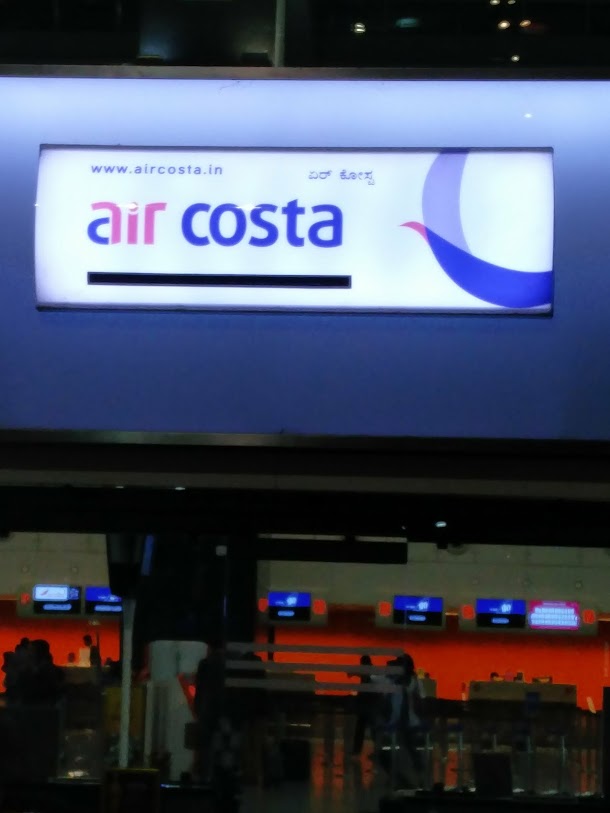
                              Followed by Air Costa

Then the newcomer TruJet.

              Lastly to Vistara another small domestic airline.

Those are the 8 domestic airline counters that I visited.

Then I went to a few international airline counters, starting with the popular German airline Lufthansa.


                     Then Air Arabia.. from West Asia.

                                           Later Air France / KLM from Europe.
There might be more international counters, but I was tired and wanted to just get home.

And finally, our dearest "India's National Carrier" Air India's counter.

Now... Did you observe carefully the 12 pictures posted above?

1) ALL the 12 display boards at airport counters of these airlines, had English prominently displayed. That's because English is the language of business in Bengaluru for white collar crowd, and no one doubts it.

2) Eleven out of the 12 display boards had a small Kannada writing. Kannada is the state official language where this airport is situated, and all the businesses respect the state language by putting a small mention of their name in Kannada. Those who can't read English, will use this. Though for most part it is ornamental in small font as most get their business done with English writing only.

3) Only ONE airline put Hindi in the display. That too with equal size font as English, and positioned above English. Also, this was the ONLY airline which did not put Kannada on the main counter display. And most importantly, this was the ONLY airline whose staff is paid salary using the tax money generated from Karnataka.

I wonder....
  • It is not about for one language or against one language. But how come 11 airlines, including the French, Arabian and German ones understand the basic business etiquette of Bengaluru, but India's "national carrier" does not? 
  • Don't the Air India staff who work at the airport see other boards right next to them daily, and ask themselves.. how come we are ignoring Kannada and putting Hindi on the board, while none of the other airlines, including those from France, Germany or Arabia are doing it?
  • If Air India has to put Hindi display, let them put it. I don't think most people will have any issue with it. If you observed, Air Arabia from UAE is putting Arabic display in Karnataka and no one has issue with it. But Air Arabia is also having common sense to put a prominent Kannada display on the same board!

This is a classic example where business is NOT the primary purpose, but promotion and demotion of languages is... Very disappointed with this irresponsible attitude of Air India and more so because my tax money is paying such people's salary :(

Wednesday, September 14, 2016

Kaveri: Current Situation in Karnataka's Dams

Background: It is the second week of September 2016. A very bad week in south India. Lot of disturbance, violence, animosity etc. It is that season of the year where Supreme Court gets involved and Kaveri is a big topic. This year, it went way worse than the previous few years due to many reasons. 
  1. In 2012, I had written a comprehensive writeup on what is the Kaveri issue, what are the issues from Karnataka's side, what are the issues from Tamil Nadu's side, and how this can be solved in the long run - Kaveri River Water Sharing : What Are The Solutions? I had listed 10 solutions, based on what I read from experts. Now more solutions have come up too, like desalination. 
  2. In 2016, The same has been used in this better articulated Quora answer. - How can the Cauvery (Kaveri) river issue be solved?

For those who want long term solutions, and points of view from both states, please spend time in those links, and also check out references from each. You will learn a lot about actionable steps!

This analysis is Not for YOU: And those who are busy distributing violence videos, sarcastic or insulting memes, chest beating that Kaveri is only "ours", please continue doing that. Don't read this any further. Because my intention is not to discuss any point that is fruitless when it comes to final water sharing details. I am more focused on actual figures, statistics and actionable steps.

What is the water situation in Karnataka in September 2016? Now the rest of this writeup would be purely showing the water situation in Karnataka's Kaveri basin as of September 13th, 2016. This is fully using a fantastic analysis done by a Twitter user named V Vinay - @ainvvy . He calls himself a curious academic entrepreneur. Again, all the information provided from this point on wards, is only from Karnataka's dams, as I did not see any qualitative analysis or data from Tamil Nadu's dams. If you know, please share in the comments and I will update here.

Names of Dams: Mr. Vinay managed to download the daily inflow and reservoir levels at the 4 Karnataka dams: Harangi, Hemavati, KRS, and Kabini.

Water Measurements: Before getting into the data, we need to understand TMC and cusecs. For historical reasons, the measurement is in terms of cubic feet. 1 cubic feet is roughly 28.3 litres of water. cusec stands for cubic feet/second. Or as @sheksis joked, 28 Bisleri bottles/second... More relatable :)

What did Supreme Court say on 12th September 2016 in the modified order? 
The current SC order for example asks Karnataka (KA) to release 12,000 cubic feet of water every second. TMC is a thousand million cubic feet, which is a billion cubic feet of water. This is 1,000,000,000 = 109 = 1 billion cubic feet. Also, important to note that this has NO component of time involved here. It is just a measure of water. 

So if 10,000 cusecs of water is released for a day, it amounts to 0.86 TMC of water. 15K cusecs amounts to 1.3 TMC a day.

In Human usage terms: To get a sense for these numbers, how much of water is used for drinking, washing cloths, bathing etc. In other words how much water is needed for human in Indian terms, per day? It is usually taken to be about 100 Litres per person per day. This translates to a little over 3.5 cubic feet of water. Do not compare with other countries where more water is available per capita. @abhicrux said, 135 liters/person/day is used for standard hydraulic calculations. All uses included. Rural south India gets less than 100 liters today. So we will go with 100 liters on the average side per person, in a water starved south India. 

Drinking Water Needs of Karnataka's Kaveri basin: The estimated number of people in Bengaluru, Mysuru, Mandya and other Kaveri basin areas is about 1.6 to 1.8 crores. This amounts to about 0.063 TMC of water a day. Let's call it drinking water, even though it is for other daily use purposes too. Essentially anything that is not related to irrigation which is the primary user of Kaveri water. Note that not all parts of Bengaluru get Kaveri water. This computation is only for the areas getting Kaveri today.


Taken over a year, it amounts to about 24 TMC of water. This is the water that the state needs to have to take care of drinking water needs. Of course, there will be losses of all sorts, so the figure is likely to be more like 35-40 TMC. Losses are usually in the form of evaporation loss, distribution loss and leakage from dams and pipes.

Water in Dams of Karnataka: Now let us get back to the 4 dams. Harangi has a storage capacity of 8 TMC, KRS in Mandya district has 45 TMC. This is the biggest and the most important reservoir in south Karnataka. Hemavati has 35 and Kabini has 16. That totals to about 104 TMC that can be stored MAX by Karnataka at any given point of time. With around 750 TMC of water estimated for Kaveri river as a whole in a good monsoon year, this is about 14% of Kaveri water that can be stored by Karnataka, at any point in dams.

This is the capacity. Current levels as of September 13th 2016 are at about 5 in Harangi and about 10 in the remaining three. They add up to 35 TMC in total across ALL dams in Karnataka on Kaveri basin. All these are computed with live storage of water without getting into dead storage analysis (which amounts to water that can't be released from dam at the bottom). An additional discharge at the current levels of 12000 cusecs to TN over the next 8 days will mean 8.3 TMC of water. Since some of the water will surely be released for other purposes, and with some inflow, the likely level in 8 days is 25 TMC. Again 25 TMC in total across ALL dams in Karnataka on Kaveri basin. This 25TMC is what we will have to survive with until June-July of 2017 when you will see south west monsoon filling in dams again. That is at least 9 full months with 25 TMC of water, if no further rains happen :(

What about farmers in Karnataka? Forget irrigation using above mentioned water levels. Farmers are screwed in Karnataka for this year! You need 100 to 150 TMC of water for irrigation for rest of the year in Karnataka. Not sure if they could even get one full crop this year, while Tamil Nadu is planning for the second crop now, and might get a third crop also early next year. This is the fundamental reason why Karnataka was burning for days in September 2016.

Dynamics of Dams and Inflow Analysis: Let’s look at the dynamics of the dams. Vinay's data starts from 2011. So we have about 5.5 years of data. Here is a table of the total inflow into various dams. Kabini has small capacity but matches Hemavati in inflow.
As you can see, Harangi and Hemavati sit behind KRS, while Kabini is ‘independent’ and joins later.


Keep in mind that some outflow from Hemavati can be inflow to KRS, etc. Vinay focuses on KRS and Kabini to look at the data more closely.

Here is Kabini. Most of the water in the months of June to September.
And then the inflow dies down. Look at September. This time we are done through about 10 days. And the inflow has been a mere 1.5 TMC!
Likewise, KRS dam near Mysuru, has got an inflow of 3.3 TMC for the first 10 days of this month. Will it hit 10 for the month?

Then Vinay plotted the reservoir level and inflow for KRS. This graph is revealing. Notice how the reservoir level shoot up at monsoon (where the inflow is heavy) and how it progressively decreases until the next. There are small inflows in between, but noting compared to what happens during the monsoon.
And notice the 2016 inflows and reservoir levels. It is quite pathetic. So the usual inflow after monsoon will also be limited this year. Usually, post September of any year, the inflows are about 25-30 TMC. We don’t see it happening this time. But we don’t have enough data to predict.

What's for Karnataka for rest of 2016 and first half of 2017? It is going to be a very tough year at this side of Karnataka. Farmers are already ditched for 2016. Drinking water might be barely sustained at the current storage levels, for the next 9 months. See above graphs and inflow analysis.

Vinay says that Tamil Nadu gets two monsoons and has better groundwater than Karnataka. Some people are disputing this two monsoon theory, but what Vinay means is that Tamil Nadu gets both South West and North East monsoons. Remember Chennai floods in 2015? That was the North East Monsoon season.

After reading this analysis, it became very clear why Karnataka farmers and Kaveri delta drinking water users, are absolutely outraged at the current situation of draining the remaining precious water from dams. Every TV channel in Karnataka is saying the same thing - We have no drinking water.. why are we being forced to leave the remaining water for growing 2nd crop in Tamil Nadu? Drinking water takes precedence over everything else when it comes to human needs. 

Any Suggestion for Politicians of TN and KA? The two states need to demonstrate better sense than landing in court every time there is a distress. Lack of sagacity is the problem. For those who say the Supreme Court would have ‘looked’ at the data and come to the conclusion, Vinay says, he does not know. These graphs don’t seem to suggest so…

There is more in the data, but Vinay says that he will take it up on some other day.  Vinay got all these data using a simple python program… shouldn’t take more than 20 minutes for a programmer to write.

Let's stop here, hoping wisdom prevails all around. I don't think a blog or set of tweets can change politics, courts or tribunal happenings, but this is only meant for common people like you and me, to understand the dire situation in Karnataka today.

Source of Data for Karnataka's dams and water levels: https://www.ksndmc.org/Reservoir_Details.aspx

I wish I could find similar data on Tamil Nadu's dams starting with Mettur for September 2016, to see how good or bad the situation is for Tamil Nadu farmers. Again, if you have similar data from TN, please do share.

Thanks again, Mr. Vinay for a classic analysis.

Sunday, August 28, 2016

Meet Captain Naveen Nagappa - Kargil War Fighter

Jammu and Kashmir is again in news.

50 days of curfew, non stop media coverage, 10s of crores of Rupees coming from Pakistan to sponsor stone pelting, anti India slogans in the so called "human rights" events, with natural reaction against anti nationals from Desha Bhakta students on streets, and much more. So I attended the well publicized and very well attended Nilume event today in Bengaluru. This Nilume group is the most active group of Kannada bloggers today with 1000s of highly creative writers. I went there to understand the situation from three different angles:-
  1. One from police angle narrated by the former Commissioner of Police of Bengaluru city, Mr. Shankar Bidari
  2. Second from a researcher, professor and journalist angle narrated by the popular Kannada writer Mr. Prem Shekhar. He has also written books on Jammu and Kashmir.
  3. Third from a Kargil war veteran, Captain Naveen Nagappa, who fought valiantly to protect India's sovereignty in the Himalayan hills in July 1999.
I was thoroughly impressed with Mr. Bidari and Mr. Prem Shekhar's narrations. They covered the issue from human rights, army morale, history, blunders of Nehru, British and US bias, geo-politics and war perspective. They were outstanding. Between them, they spoke for over 2 hours, so I will try to narrate their talk a little later on Facebook and Twitter. I knew both of them and admired them for years. Awesome gentlemen!


Here, I want to jump straight to Captain Naveen Nagappa. Honestly, I did not know about him till date. Shame on me! I did not know about a valiant Indian army man who not only fought bravely at Kargil protecting us, but also survived a serious injury to tell us the story. But it is never too late. So you can learn more about him here..

It was January 1999. A young Engineer from Karnataka called Naveen had joined Indian Army, instead of going to do Masters Degree in Engineering. He had great dreams of protecting our Bharat and had become a part of 13th Jammu and Kashmir Rifles group. This was the group of Late Captain Vikram Batra, of "Yeh dil maange more" fame. This battalion got numerous awards during the war for supreme sacrifice. Our of the 4 Param Vir Chakras awarded during Kargil war, two were given to his JK Rifles unit.

While he was just getting started with his army career, General Musharraf and Pakistanis were planning and executing something sinister. They were breaking the Gentleman's agreement between India and Pakistan of vacating the 16000 feet plus altitude hills during extremely bitter winter periods. They were not only occupying the Kargil heights, but also were building bunkers and getting ready to shell Indian army's vital Siachen and Leh supply routes from Srinagar in Jammu and Kashmir state.

Things came out open in May 1999. But June Indian army was fighting to capture the hills back, one by one. When Naveen's team was sent in early July to capture a vital hill, he was put in reserve.
Point 5140 was where the big battle was starting. Captain Batra and team had already fought there, but Naveen was not given a chance to fight. His team was sending radio signal, including "Yeh dil maange more" kind of awesome slogans. But Naveen was not fighting in the open. He desperately wanted to.
 When his team was given a big task for 3rd and 4th July 1999, he went and pleaded his chiefs like General Yogesh Kumar Joshi. Naveen pleaded that he did not leave his chance for Masters in Engineering, and come all the way to Jammu and Kashmir borderline, to just stay in the reserve. He wanted to fight. His boss asked - You are here only for 6 months in the army. Not only your safety, but also the safety of 120 people who are with you matters, with your split decision. It is not easy. But Naveen did not quit. He kept on requesting and finally got the stamp of approval to lead a mission.

Super excited, Naveen was on the mission to liberate "Point 4875" near Kargil. Captain Batra had told Captain Nagappa one simple thing - "Naveen, you take care of your men, and they will take care of you". So Naveen started his expedition with JK Rifles' war cry - "Durga Mata Ki Jai"!
Location of Point 4875. Source: http://lazydesiauthor.com
We have heard more of Tiger Hill and other popular named hills. But a few of these numbered hills were vital to get to the top of Kargil mountains where Pakistanis had setup bunkers, so that they can be kicked out of Indian side of Jammu and Kashmir. So the battle started on 4th July 1999. Incidentally the day of Vivekananda and US independence too! Personally, I had just crossed oceans at 38,000 ft to get back to India that morning, but had no clue that supreme sacrifices were being made exactly at that time by the brave jawans of India.

Naveen and team had followed the same buddy system that army follows. Everyone who goes out in the night for attack, is paired with another brave soldier. Their job is to make sure that if something happens to one, the other would take care of it. Naveen had just seen his buddy suffer badly the previous night. But there was no going back. He had to fight on 4th morning, 4th night, 5th morning, 5th night, 6th morning, 6th night... They had to melt water from snow capped mountain for drink and eat some energy food carried with them. They could not move easily as the enemy was in higher location and had clear sight of them. But their mental power carried them. Why? They had heard about how Pakistanis had tortured Late Captain Saurabh Kalia and team who had gone on a fact finding mission earlier. They had heard about the gory details of brutally Pakistanis had taken out organ by organ of the brave Indian soldiers who were taken as Prisoners of War. They had heard about how after torturing in the most inhuman ways, Pakistanis had shot Kalia and team at point blank, before "returning" the bodies to India. When you hear such barbarism and brutality of your enemy at front lines, you just get the energy to hit back. No question of fear or family or tiredness. That was Captain Nagappa and team during those extremely difficult moments of July 1999.

They kept fighting bravely. And then a grenade landed in front of Naveen. He was trained on how to handle a grenade when it lands. Usually you have 6 to 10 seconds. A grenade can kill everyone within 10 meters radius. So the first instinct of Naveen on 7th July morning was to just pick it up and throw it away. But a body that has been fighting non stop for 100+ hours can't really throw a grenade back 100s of feet as they show in movies. Unfortunately, the grenade came back after hitting a boulder.. Now Naveen had 2 to 3 seconds!!

His thought was - Anyway the explosion will happen now. I have no chance of escaping. At least, let my upper body go back home in one piece, rather than piece by piece in a bag. So he hid his upper body from grenade and exposed only his lower body. Booooom.. the explosion happened and before he knew what happened, he was in severe pain. His legs were hit. But in a conflict zone, you can't just get away after being injured. Any movement will attract more bullets. So he controlled his extreme pain of both legs being damaged and still fought on. But his team observed and asked him that he should crawl from the mountain to the bottom slowly. He did not agree, but they convinced him that he had to do it as he was seriously injured. With great reluctance, Naveen left his team to fight further, and crawled back to the lower heights very slowly. As you can imagine, he would be in tremendous pain and losing blood rapidly. Still he made to the bottom. The first thing he did there was to remove his snow shoes which are below the knee, but above the ankle. And then he realized how hard he was hit as his blood turned a few feet of snow around him red! He had literally spilled half of his body's blood for Bharat Mata, in an un-named hill, 1000s of KM from his home.. what a spirit! Still he wanted to fight barely having consciousness.

Even there, you can't expect a quick evacuation as the enemy was a higher position, observing everything. So it took lot of time. Finally after hours, he was given basic treatment and taken to the nearest helicopter. With great reluctance, he had to head away from the fighting zone, in the army helicopter taking him to Srinagar. And when the chopper took off, at a lower height to avoid firing from higher hills, he was losing consciousness due to heavy blood loss. Just then his chopper flew past Point 4875 for which he almost sacrificed his life. And there the Indian national flag, the tricolour was flying proudly!! After watching it from the army chopper, under lot of sedatives to kill the pain, he finally closed his eyes in total satisfaction. YES!! My boys have done what I went there to do......... What a relief!
His mind was -

"Naveen.. You have left a legacy behind.. whatever happens after this is irrelevant. Whatever role you were meant to play, you have played. You have created history".

Then he spent 21 months in the hospital undergoing treatment. He had to undergo 8 surgeries. He got the Sena Medal. His spirit kept him going even when the bravest of human minds crumble when hospitalized for such a long time.

And he narrates one other thing from his hospital stay. The mother of his close friend from army came from Dilli to visit him. She had lost her son during the same battle. Naveen could not sleep the prior night as he did not know what to tell that Maa, about her son. He could not digest that fact that he was alive, but his close friend soldier had made the supreme sacrifice for India. She came and met him. He talked with his "aunty" with lot of respect. They talked for 2 hours, but she never asked about her son not returning. Naveen could not take it anymore when she was about to walk away. He asked her.. "Aunty.. I am extremely sorry that I could not get your son back, while I survived myself". She told in a calm way - "Naveen.. it is the best honour for a mother to see her son wrapped in a tiranga. I am proud of my son". No need to highlight that when Naveen narrated this today, he got loud claps from the emotional audience in Bengaluru.

Why am I writing all these 17 years later? Because when I was busy building my high paying corporate career in 1999, these young men, some younger than me, were busy shedding their precious blood drops for Bharat Mata. As I am typing this, I am sure 1000s are taking extreme risks in the Himalayan mountains, rough seas, dangerous central Indian jungles and much more. During every real estate purchase we do, ever mall purchase we do, every road trip we take, every party we enjoy, every cricket match we cheer for, every political rally we attend, every TV show we watch, every birthday party of kid we celebrate.... there is an Indian army soldier making a split second decision whether to sacrifice his upper body or lower body because that grenade is about to explode. Either he is facing the situation in real, or training hard in drills. Sooner or later that situation would come for many brave fighters as we are surrounded by internal and external enemies.

Hold these brave soldiers with the highest respect. We have NO IDEA of what they go through.. when you can't even take out your shoe for hours to check if your bleeding legs are still attacked to the knees or not, THAT is sacrifice for mother India. That is what 1000s of these Jawans are paying with their blood for our safety each year.

Oh.. did I tell you that all the tall promises politicians made to him - nothing has materialized till date :( You can hear his narration here, from an earlier event.


You can read about another narration of meeting with Captain Nagappa here. They have posted one memorable picture from Kargil times.


The next time you hear some nincompoop talk of "human rights" or "azaadi" slogans against these brave Jawans, just ask them to go speak to brave sons of Bharat Mata like Captain Naveen Nagappa in Bengaluru. I can take them personally.


Freedom is not free. It takes a lot of blood, sweat and tears to protect it. DAILY!

Tuesday, May 24, 2016

Propaganda Against Venkaiah Naidu.

It has been a long time since I blogged on any topic. There were many chances, but I procrastinated and lost the interest eventually.

But today, I got a chance. So enjoy reading :)

Venkaiah Naidu flagging off Namma Metro. Pic: Indian Express
For the past week or so, social media in Karnataka is abuzz with Venkayya Sakayya (enough of Venkaiah) kind of messages. First there was a big column in Vishwavani. It was followed by other news paper reports and countless memes floating on Facebook and Twitter. TV stations also might be picking it up by now. The core message was to force BJP to not give Venkaiah Naidu, a fourth term to Rajya Sabha from Karnataka. For a casual observer, Venkaiah Naidu is usually in news whether in parliament or his rhyming word speeches, or his frequent photo ops for important events.

Initially I was  not interested in this. Didn't read or comment much on this. But when I saw that it was a well organized movement, just posted one casual tweet.


Of course, my focus was Congress supporters who were sending me tweets for a week. I knew quite well that BJP and JDS supporters were also in this campaign. But I thought I will handle them later :)

Posted a similar message on FB too. I thought it was just one off post on this topic and time for a good night's sleep.

I was surprised with the reaction. It was from all corners. Highly popular FB poster Vivek Shetty picked up this tweet and posted on FB where it went viral. Within hours, 100s of reactions started pouring in. I tried to answer a few dozen initially. Then it became difficult to keep up. Emotions were flying around.. Some abused me.. Small number praised me. Most argued that it is a bad choice to support Naidu.

The fact of the matter is - I have no favourites among the 12 Rajya Sabha MPs from Karnataka. Rather, I hardly care. For me Legislative Council, Rajya Sabha, Governors' offices and President's office are things that are mostly ceremonial. I don't spend much time talking about them. Hence I was very surprised at the amount of interest by youth, particularly the emotion part! How can anyone be so interested suddenly on as trivial thing as reelection of a Rajya Sabha MP? Every 2 years, RS keeps getting people coming and going.. No one really pays much attention, but this was different.

Here is how things went parallelly across Facebook and Twitter. Let me sum up.

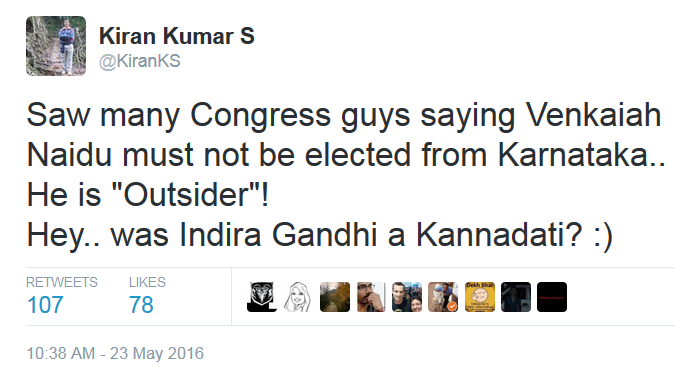
I said: Indira Gandhi was also an outsider. So what's the big deal with Venkaiah?
They said: So you are saying BJP can do the same sins that Congress did? What happened to Party with a difference tag?

I said: Not that way. From when did we get so touchy about "outsiders" in Karnataka? Sonia Gandhi won in Ballari (which she dumped quickly). Many "outsiders" have gone to parliament from Karnataka. Why suddenly touchy about Venkaiah's fourth term?
They said: Lok Sabha is different from Rajya Sabha. Here you are nominating, and not getting elected directly.

I said: OK. Then how do you feel about Chikkamagaluru, Karnataka, born Jairam Ramesh going to Rajya Sabha from Andhra Pradesh? He was in RS for 12 years since 2004. Isn't that case exactly reverse of what you are opposing? How do you justify Manmohan Singh becoming India's PM from Asom's RS quota?
They said: Who cares? That is up to people from AP or Asom to oppose.

I said: So you are OK with Sonia Gandhi winning from Karnataka. You think it is their problem if someone elects a Karnataka born person to RS from their state. What is your core issue with Venkaiah?
They said: He does not work for the development of Karnataka. He is too partial towards AP.

I said: OK. Let's examine facts. You know that Karnataka has a quota of 12 RS MPs. Have you even examined how all 12 have done before shooting on Venkaiah?
They said: Again, he has not done anything for Karnataka. That's the point.

I said: Let's go to details. Here are the 12 MPs from Karnataka in Rajya Sabha as of May 2016. Number 9 is vacant as Vijay Mallya was allowed to quit a few weeks ago. Have you done any comparison of how Naidu has fared against the rest? Keep out "Bhakt", "Sanghi" and other blah blah from discussion. Let's compare people across all parties.
List of Karnataka RS MPs - May 2016. Source Wiki
They said: We know that Venkaiah has not given any money towards Bengaluru's development projects. See Vijaya Karnataka and other paper articles.

I said: Let's go straight to the parliament website. The link is here: Then dig into Karnataka MPs using the MPLADS funds. These funds are sanctioned by the government frequently, based on the amount requested for their constituency's development activities. Venkaiah has done a very good job in using 92.35% of the allocated funds, while Rajeev Gowda of Congress has a zero in the utilization percentage! How can you say Venkaiah is not working when there is an MP listed right next to him with zero development funds utilization in 2 years?
Usage of MPLADS funds by Karnataka RS MPs
They said: *Silence for some time*. Yes, it does seem impressive for Venkaiah. But he uses the funds in Andhra. He adopts villages there.

I said: As far as I know, the funds are for the constituency specified by the Rajya Sabha website. He can't use it in another state.
They said: Whatever..  He is too focused on AP. He adopts villages in Andhra, but not in Karnataka where he is an MP from.

I said: Are you sure? Just go to Sansad Adarsh Gram Yojana website and see which village he has adopted. It is from Devanahalli, north of Bengaluru city. He might have adopted a village in AP after the cyclone in 2014, but not under Adarsh Gram Yojana.
Village Adopted by Naidu

They said: Oh! We were told by 100s of people that he adopted Andhra village. Anyway... he does not speak Kannada. He does not talk in the parliament about Karnataka matters. He does not wish for Karnataka Rajyotsava.

I said: That's a valid point. We can tell him to wish. We can ask him to pick up matters. For that matter, even Sonia Gandhi who won from Ballari, does not wish for Rajyotsava as far as I have seen.
They said: Just because Congress does some mistakes, why BJP should do it? It was NDA that changed Rajya Sabha rule to elect people from other states.

I said: That's not what I know. MS Gurupadaswamy of Mysuru, got elected to Rajya Sabha from Uttar Pradesh (1966-72). Forget NDA, even BJP wasn't born!
They said: *Silence*. But it is wrong from federal structure. We should only send people who are from that state to Rajya Sabha. Enough of money bags and outsiders using our state and not doing anything for us.

I said: Just to give an instance (not comparing with Venkaiah in any way) - Dr. Ambedkar was from Bombay. Got to parliament from Bengal. Bengalis didn't ask..you failed to get elected from home state. Why should we help?
They said: Hmmn.. we were told that it was BJP that tweaked rules. In any case, both BJP and Congress are useless parties that surrender to Dilli High Command. We wish a regional party like JDS stands up for Kannadigas. High commands enforcing candidates in spite of opposition from people is not right.

I said: Do you even know the kind of people Deve Gowda's Janata Dal sent to Rajya Sabha?
They said: Better people than Hema Malini or outsiders that national parties send.

I said: What did the "local" Janata Dal do? Sent Sindhi Ram Jethmalani, Tamil MAM Ramaswamy and Telugu Kupendra Reddy to Rajya Sabha! Some said they even supported Malayalee Rajeev Chandrashekhar's candidacy (I don't remember properly). How do you justify them?
They said: Now you are deviating.. It is not about language. Reddy is local to Bengaluru at HSR Layout.

I said: So is Venkaiah now. He is a voter from Malleshwaram area. Indian constitution considers him as a resident of Karnataka. So what's the issue?
They said: Frankly, he does not speak for Karnataka issues. He never spoke for Kalasa Banduri issue. He is too focused on AP issues. Why doesn't he go there and get elected?

I said: Now you are talking about real issues. So far I had not come across any valid comparison to be made to other MPs. Let's go further. Let me ask 5 questions on how other MPs from Karnataka have performed recently in Rajya Sabha. Here I go..
They said: *Silence for some time*. You should ask the editor of papers who campaigned against Venkaiah to answer this.

I said: It is not about the editor of newspaper. It is about facts. If you are measuring Venkaiah using some parameters, why not ask the same for others? If you are opposing Venkaiah Naidu's Rajya Sabha reelection, oppose based on data. Show how other 12 Karnataka RS MPs have done better.
They said: This might be a game played by Congress with the help of Media in Karnataka. There could be reasons right from the dynasty at the center of whom Venkaiah is very critical. After media took over, BJP supporters too joined in.

I said: I have not seen anyone telling how Rajeev Gowda (zero MPLADS usage) or Rahaman Khan (no MPLADS used in 14 Mon) are better. How come no one is campaigning against them them? Development is for the state. Who does is secondary.

But as you can imagine... most have made up their mind. I only saw more arguments like he has not done anything, to vocal abuses.. I don't care much about abuses. That only shows the weakness of those who abuse.

But I left these discussions shaking my head.
  • Frankly, I don't care if Venkaiah Naidu goes to parliament from BJP again. 
  • Frankly, I don't care whom Congress or JDS send. At the end it is usually the most influential or money bags that become Rajya Sabha MPs or MLCs at state. We know that!
But what I care is:-
  • how much MPLADS funds is used to Karnataka, by those who are sent. 
  • I care how much attendance they have. 
  • I care about what kind of debates they participate in. 
  • I care about the end result - their constituency's development. What's the use of MPs getting reelected 3-6-9 times from their constituencies, but people continue to live in poor conditions? We have plenty of such examples in Karnataka.

It was too late by the time I realized that too many people have fallen to media propaganda. I have nothing against those who angrily reacted to my tweets or posts. At the end, I want the development of Karnataka, as much as they want. But I was more focusing on the parameters they used and the facts they checked. Some points might be valid, but the overall way in which Venkaiah was made a soft target was strange. Before I raised the data from Rajya Sabha website, most did not even know that there are RS MPs in Karnataka with low to zero MPLADS usage. Media propaganda is very powerful! A fair movement would have been to put all 12 RS MPs side by side, and show why Venkaiah failed in certain areas.

No one did that, or at least I have not seen it! If you did.. let me know. Naidu might be a big failure in reality, but no one is presenting that in a fair manner, with parameters that can be applied to other MPs too. After all, a state's development can't be done by one MP. It is a collective effort. Ultra regionalism without using data to compare MPs, can be dangerous in the long run. Every state would end up doing it, which hurts the nation as a whole.

Thursday, August 6, 2015

Sadbhavana Sunday

At an event on Saturday night, my friend Gokul gave a pamphlet. Hey, tomorrow, there is a pilgrimage tour, do you want to go? I was like to which place?

In Bengaluru!

I gave a strange look. In Bengaluru? That too a day long pilgrimage? Then saw the details and got excited. Why not? So was on the pilgrimage bus at St. Mark's road at 7.30 AM. It was a good decision because I was going to enjoy the day thoroughly.. In what I call in Modi's lingo as "Sadbhavana" Yatra :)

This is organized by a Catholic Christian group in Saint Mark's Road. Most of the occupants of the bus were Christians, but there were some Hindus like me. There was one Muslim and one Buddhist. More than the composition, it was the interest of the people in other modes of worship, that was important.

All the areas we went are tracked in this map. 


1) Shri Dharmanatha Shwetambar Jain Temple, Jayanagar. 

Jainism for me is one of the Guru Paramparas of Dharmic India. But politically it is a different religion. There are two kinds of Jainism. Shwetambara and Digambara. We went to a Shwetambara temple where the prime deity is Shri Dharmanatha. He is the fifteenth Tirthankara among the 24 highly revered Jain Gurus. It was nice to see women putting pastes (Shri Gandha?) to various parts of murtis, the swastikas drawn with rice, the pious women monks who were busy in prayer and much more. This is a prayer place for many Rajasthanis in Karnataka.

Devi Padmavati's temple is in the back. Nakoda Bhairav and many other murtis exist in this temple complex. Beautiful white marble temple with soothing bhajans :)


2) Mahabodhi Buddhist Temple, Gandhinagar.

This Buddhist temple was getting decorated by the time we went in the morning, for their special Sunday prarthana. It's a beautiful temple with a Bodhi tree (Peepal). I saw some idols of Buddha gifted by Thailand as Thai language were written at the bottom. This center has mostly North East Indian people settled in Karnataka. This center follows the Theravada sect of Buddhism. Theravada as far as I know is a synonym for Mahayana type of Buddhism, which is different from Hinayana or "smaller vehicle" Buddhism. Buddhism again for me is a different Guru parampara in Dharmic traditions, but technically it is a religion now.

It was so nice to hear nearly 2500 year old Pali language prayer being sung in a melodious way. You have to follow men and women sections in the temple and a great place for meditation. 2500 year old glorious Indian culture comes right in front of your eyes hearing the powerful Pali hymns!


We also got nice breakfast served by the Buddhist monks. Our favourite Uppittu was made nice by the North Eastern friends :)


3) Yaqeen Shah Wali Dargah, Palace Road. 

Dargah is a type of Islamic place where a Muslim Guru or Peer's tomb exists. Not every sect of Islam accepts Dargahs, and some term these as UnIslamic.

This Dargah in my view is maintained by Sufi sect of Islam. If not, Shias. We were treated well here. There are restrictions. Women can't enter the main Dargah part, but can come near. Head cloth is suggested for men and women.


I went inside and stood next to the religious man here who sings praise or prayer. It was a soothing song and he later translated. He explained that on behalf of everyone who was there, irrespective of faith, he prayed for their welfare. I was particularly interested in the hand figures, and what they represent. The symbolism of these Hand signs and other rituals performed here had lot of Hindu influence.


There is a small mosque also in the complex where they read Namaz. Had a lot of discussions with the Dargah staff on who was this peer, how many centuries ago this tomb came up, difference between Sufi and Sunni Islam and much more. They were open in answering all. Served nice tea too later.

4) Catholic Chapel, Thomas Town.

The next visit was to NBCLC - National Biblical, Catechetical and Liturgical Centre. This is a very different type of Christian complex. It is not a typical Church, but a full inculturation center. For some inculturation is a good thing after Vatican 2 in Christianity where the European cultural way is making way for native - here Hindu, cultural way for Christians. For those who oppose this, it is a process of stealing from Hinduism. We can have that debate some other time, but let me just narrate the experience there.

Everything is "Hindu"ised here. From names of buildings to dress to window pane drawing to gopura (top of Chapel).. I mean everything! Building names are Sacchidananda, Brahma vidya, Shanti sadan etc. You won't find a saree wearing Mother Mary sitting in padmasana, with and Indian dressed baby Jesus like this anywhere else in the world.


Here, the resident sister explaining the central point of the Chapel. The whole building and the central God and Jesus concept is built on Hindu Kundalini Chakra concept. It is just narrated in a different way, which you might not find in the Bible.


A Catholic lady from Mumbai who was with us, explained that at the start, Christians find it difficult to pray in a place like this with Indianized (Hindu-ized) symbols. But later they feel much more home than a European style Church. I was explained how multi cultural symbols are so essential for Christianity in today's world. I talked to a few Fathers/priests too who told the same thing. There are courses conducted here in inculturation for Christians from around India.

5) Guru Singh Sabha Gurudwara, Halasuru.

The next stop was by mid day to Sikh Gurudwara. Here, cloth over head is mandatory. They provide it right in the front, and even tie to your head if you wish. I found the discipline of Sikh devotees simply amazing. Men, women and children come inside in strict lines and bow before the Granth Sahib (holy book). There's a Granthi who reads from the Guru Granth Sabhib book. There were narrations in Punjabi language on heroes of Sikhism, how weapons are needed for self defence, how to sing Kirtans and praise the Gurus and more. I think the term for singing before meal was Ardas. I also saw people having a small knife as a part of the 5 basic tenets of Sikhism, called Kirpan. Women too had turbans in some cases.

This is one place where we spent maximum time. I heard many songs or Bhajans. They were sung melodiously and they were so close to how we sing bhajans at Hindu temples. Again, I found this just another Dharmic place, but we are told it is a different religion. I felt completely at home even though I understand only basic Punjabi.


The most impressive part of Gurudwara was after the soothing prayer session. There is a community kitchen called Langar, where anyone can go and prepare food. There is free food served for anyone who comes, no questions asked. Just keep a cloth over your head and take food obediently the way everyone else takes. I was amazed at how 100s of people, men and women - went about contributing to food preparation. The amazing discipline in preparation, serving (every serving is praised on Wahe Guru), and cleaning up. It's like you can be anything in this Gurudwara. You can sing, preach from the holy book, clean, cook, keep shoes, volunteer at gate... anything! A truly open system.


I had never seen in my life, well to do middle class people coming and cleaning up plates after lunch, with bare hands. Never.. These are well to do middle class people. I literally saw people using thumbs to wipe out the plate after we ate, to remove every single grain or vegetable piece onto other containers. They probably don't waste a single grain. Just amazing! And next step was another bunch of volunteers cleaning up with water and making the plates ready for the next round.


After enjoying a great prasad (offered food) at Gurudwara, I was thoroughly satisfied with what I saw. The discipline and Bhakti at a Gurudwara is something you just have to see for yourself!

6) Masjid al Nur, Halasuru.

The final stop for me was the Sunni Muslim mosque. It's a big and grand mosque built not many years ago. We went at a time when Muslim prayer, or Namaz was not being read. So we had a chance to go on a guided tour, well conducted by a friend of mine, Syed. Head cloths over head are mandatory during prayer, but was kept optional for visitors on guided tour. Also, for women, there is a separate prayer hall opposite to the main mosque.


Unlike other places of worship we visited, this Mosque had lots of questions from the team. People asked questions right from namaz direction, to where women assemble, to what's inside Kaaba etc. Syed answered everything very patiently and showed us things. Right from Wazu, where you use water to clean before prayer, to how prayers work, how many times, why pray, what are the key tenets of Islam and much more.


The team came out much more educated about Islam after this trip. Of course, we were served nice soft drinks and biscuits outside the mosque.

In summary...
The pilgrimage was later going to Hindu place of worship after this, but I had to drop out due to another engagement. I am not unfamiliar with Hindu temples and ashramas anyway :)

All pictures in here if you have more time.

Some more videos if you want to watch:

So here is the final collage.. A memorable day wherein I learned a lot about fellow Bharatiyas! After all, we are all very close to each other as humans, and once we understand the differences clearly, we can find ways to co-exist with minimal friction. The primary goal of every mode of worship is to make you a better human. That's what is Sad (good) Bhavana (feeling or intention) :)

Try it once.. You can do it yourself, of go with an organized pilgrimage. Contact Ashirvad, 30, Saint Mark's Road in Bengaluru for the next trip.