Showing posts with label English. Show all posts

Monday, February 13, 2017

Airline Displays at Bengaluru Airport

This one would be a very quick blog post, with pictures. And less words compared to my earlier blog entries.

During the past two moves through Bengaluru's Kempe Gowda International Airport, I noticed this. A few weeks ago, heard the same in a talk at Munnota bookstore in Bengaluru. So I told myself, why not? Let's really check how different airlines are advertising themselves via their airport counters. 

As of 2016, Kempegowda Airport in Bengaluru (BIAL) is the third busiest airport by passenger traffic in India, behind the airports in Delhi and Mumbai. It handled over 2.22 crore passengers in 2016 with little less than 500 aircraft movements per day! The airport also handled about 314,060 tonnes (346,190 short tons) of cargo. So in short, I am talking of a very busy airport in India, which does fantastic commercial business.

So these airlines operating from the third busiest airport of India, based in the capital of Karnataka, must be eager to get your business and mine. So I went to 12 airline counters next to departure and arrival gates. There may be more, but let's use these 12 as comparative examples.

Here is India's most used domestic airline today. Indigo.


                                Next, Jet Airways..

                                Then, Go Air.
Then walked over to Air Asia.

                                   Then to SpiceJet..
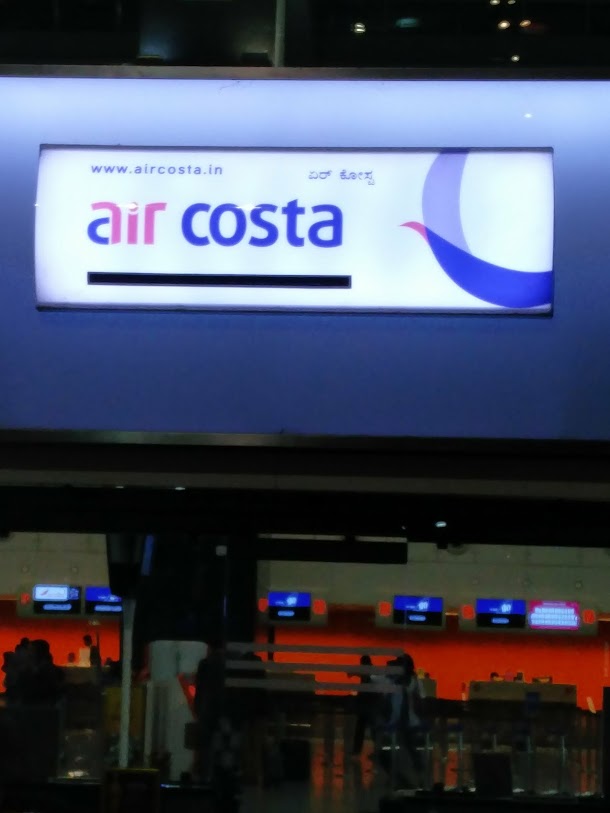
                              Followed by Air Costa

Then the newcomer TruJet.

              Lastly to Vistara another small domestic airline.

Those are the 8 domestic airline counters that I visited.

Then I went to a few international airline counters, starting with the popular German airline Lufthansa.


                     Then Air Arabia.. from West Asia.

                                           Later Air France / KLM from Europe.
There might be more international counters, but I was tired and wanted to just get home.

And finally, our dearest "India's National Carrier" Air India's counter.

Now... Did you observe carefully the 12 pictures posted above?

1) ALL the 12 display boards at airport counters of these airlines, had English prominently displayed. That's because English is the language of business in Bengaluru for white collar crowd, and no one doubts it.

2) Eleven out of the 12 display boards had a small Kannada writing. Kannada is the state official language where this airport is situated, and all the businesses respect the state language by putting a small mention of their name in Kannada. Those who can't read English, will use this. Though for most part it is ornamental in small font as most get their business done with English writing only.

3) Only ONE airline put Hindi in the display. That too with equal size font as English, and positioned above English. Also, this was the ONLY airline which did not put Kannada on the main counter display. And most importantly, this was the ONLY airline whose staff is paid salary using the tax money generated from Karnataka.

I wonder....
  • It is not about for one language or against one language. But how come 11 airlines, including the French, Arabian and German ones understand the basic business etiquette of Bengaluru, but India's "national carrier" does not? 
  • Don't the Air India staff who work at the airport see other boards right next to them daily, and ask themselves.. how come we are ignoring Kannada and putting Hindi on the board, while none of the other airlines, including those from France, Germany or Arabia are doing it?
  • If Air India has to put Hindi display, let them put it. I don't think most people will have any issue with it. If you observed, Air Arabia from UAE is putting Arabic display in Karnataka and no one has issue with it. But Air Arabia is also having common sense to put a prominent Kannada display on the same board!

This is a classic example where business is NOT the primary purpose, but promotion and demotion of languages is... Very disappointed with this irresponsible attitude of Air India and more so because my tax money is paying such people's salary :(

Friday, September 19, 2014

You Speak Your Language, I Will Speak Mine - But We Shall Still Communicate!

Let me start with a negative note:
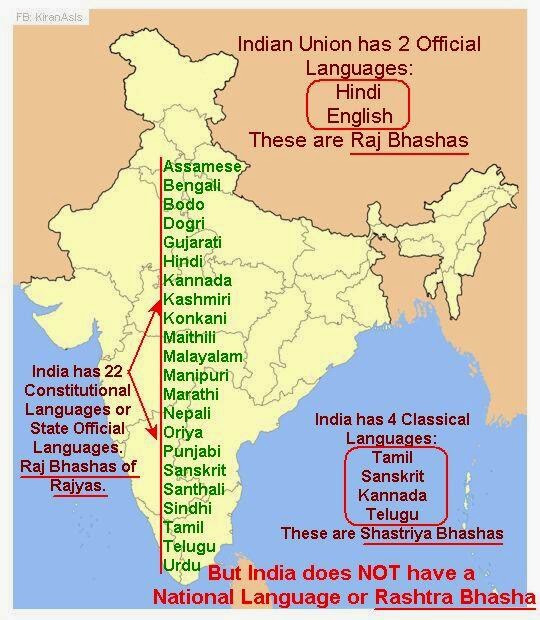
I am fed up of language barrier in India particularly, and in general globally. We humans have divided ourselves into very narrow pockets with linguistic identity. Mother tongue (matru bhasha), National language (rashtra bhasha), state languages (rajya bhasha), official languages (raj bhasha), classical languages (shastriya bhasha), link language, entertainment language, second language, third language, foreign language, invader language, heritage language... etc etc.

Here a chart that I had prepared the last time I got frustrated with language debate. Since then, 2 more classical languages may be coming up - Odia and Malayalam.


What I have learned after decades of seeing language debates and politics... Languages unite in some cases. But in more cases, languages divide us more than they unite. I don't have to give details of how languages have divided millions of Indians today.. how they have made 100s of millions of Indians see other 100s of millions of Indians as "un-Indian". The anger, the snubs, the protests, the beating, the reservations, the school politics, the ganging up, the insults.. it's just ugly in so many cases. In the height of "my language versus your language", many have stopped seeing others as a Bharatiya... or even a human deserving dignity.

The key problem is the unnecessary pride and chest beating.. If you don't learn "my language", you are not equal.. And the natural reaction is that if I abandon "my language" in government and business, it will be lost! And practically it is not possible for a regular person to learn more than 3 languages well - I mean read, write, speak and understand at high school level. With nearly 2 dozen really big languages being spoken by millions of people in each case, India is the land of language conflicts.

Frankly, I am not pro any language strongly.. I am not anti any language strongly. My take is that a language serves a purpose of communicating. Language(s) will help you get diverse information. Each have their own style and strength. They also have weaknesses. I am very proud of mine and you be proud of yours. Personally, I am all for more the merry policy! And that's pretty much it. If you start giving it too much importance and create your whole identity around a language (or opposing some other), it is not the best usage of your time. Languages evolve, borrow words, grow in vocabulary, shrink and die. It's a natural cycle. Some just undergo metamorphosis into one or more daughter languages in the course of time.

But nothing is constant. Kalaya tasmai namah. Everything that's born will die one day.
-------------------------------------------------------------------------------------------------------

And now the positive note:
What if.. we had a system in this 21st century, wherein  
You Speak Your Language, I Will Speak Mine - But We Shall Still Communicate!

Sounds crazy? Sounds impractical? It's not. Let me put in my vision and you tell me if this is possible. If possible, you are by all means free to use this idea and make money in the long  run :)

But I have some ideas.. I am sure you will have lot more. And none of these are not any genius stuff as many would already be in place in advanced pockets of our globe.

1) Let's start with a visit to a tax office, a bank or an insurance office. Take the tax office. You have to deal with a tax form as shown here. You are the "kardaata" or "tax payer" in Guwahati. What if you can't read either of the languages the form is printed in? There are 100s of millions of such Indians who can read and write, but not these two languages at an expertise level to fill in a critical piece of tax information.


No problem..
You take your mobile phone that has a handy scan app built into it, and just scan over that tax form. Or you can use a more elaborate professional handy scan machine.


Voila.. the form is fully scanned and you will see on your device an Asomiya translated version. Better, you will have the ability to key in the Cheque number, type of payment etc. right into the phone. When done, simply press a button to e-print the filled form right there. The office will have it right a the desk.
For those who can afford, it can be in their car. Almost all traffic inspectors in Bengaluru today print their traffic violation payment receipt right on the street using a blackberry phone which can print. 


The job is done. Those printing the challans have no language problem. They can print in one or two languages of their government or institution's interest. Those taking the service don't have to worry about learning the languages. They can fill in any language that they are familiar with. The important thing is for the job to get done well, easily and in an affordable manner.

2) Next - emergency instructions.

You are traveling from Guntur in AP to Mysuru in Karnataka. Almost all literate passengers in this inter state train would know Telugu or Kannada or both. But the night train has emergency instructions only in Hindi and English. Lakhs of people who travel interstate between these destinations would have difficulty reading and comprehending the vital emergency instructions.


Again.. use your phone, even the basic smart phone variety. Click the picture of the instructions. The app will then recognize the language(s) and give you an instant translation in Telugu or Kannada. Problem solved!

Some might say.. what's the big deal in reading these 3 lines? Trust me.. 100s of people died in train emergencies in India each year and even if 2 extra lives are saved crossing the language barrier, that's worth it.

It's not just train. It's for all emergency instructions. Plane, Volvo bus, LPG cylinder, inflammable fluid carriers, hazardous material handling factories, school premise, movie theater.. etc. etc.
When life saving instructions are not in the language you can read, they are NOT life saving! If we can make it truly language independent using sign languages, that's different. But at least here is some way to use the existing system, instead of changing it fully.

3) Moving on - Meeting a stranger for asking directions.

It has happened to almost all of us a few times in life. We ask for directions in a city or village that we are visiting, and invariably the language barrier comes in. In most cases, there's a genuine difficulty. But in some cases involving linguistic animosity, people are rude and won't help you. All of us will know at least 2 incidents in life, where we were shunted out just because we could not speak "their" language. In my view, it's risky to be language illiterate in India, particularly for women.

So here's a simple way out. You meet someone. Put a headphone bud into one ear.

Select the on source and destination language buttons on your phone. Boom... you can have a conversation. Your phone is acting as a real time translator. The other person also does the same. Even if the other person is not equipped with this app, your device will tell you what to tell after translation. Everything happens in real time! No interpreter needed. And adding a couple of simple Namaste, Thanks, Shukriya, Vanakkam will make the other person feel happy and your job will be done really well.

If you take the technology further and use Google Glass, you can do wonderful things without needing much human help. But Indian streets, particularly the non metro downtown areas, are a long way from actually using self-help Google glasses. So you need technology that can be simply used with existing human support that's available.


4) Then - Your PM speaks in Hindi.

Now this is a big issue in some pockets of south India and east India. PM Modi speaks in only in Hindi. Language pride and language hate politics kick in. Learn Hindi...  Don't impose Hindi groups start quarrel. If the PM were to speak in English too, the same things would kick in, but from some pockets in the North or West or center. The point is not language. It's the proficiency we have with it, and the like we have for it. Why not use mine is always the problem!

I can't solve the language problems when we have nearly 24 languages, each spoken by at least a few million people in India. It's next to impossible. For 60+ years people have tried. So what I would try is to let you keep your language and let me keep mine.

With just 20 seconds delay, all websites and TV or radio channels that broadcast PM's speech, can do a voice change-over into destination languages. The technology exists already in Europe which is yet another highly diverse India-like continent.


Europe and UN, with dozens and sometimes 100s of languages are involved, conduct business already without any barrier. We in India are still ages behind quibbling over mundane "you speak in my language" nonsense. In Indian parliament, if you have to ask a question in the 2000 year old INDIAN language Kannada, you will have to take prior permission. Unless you have prior permission, you have no choice but to switch to one of the 2 official languages, which at least 200 MPs from non Hindi regions of India are not proficient in! And they keep quiet and their constituencies suffer because of this language barrier. It's really silly and so non-federal in nature. And the same problem across all legislative assemblies where most Indian languages are shunted out even if there are people in the state speaking those languages.

So what can be done? Let the parliamentarians find their solution. We can focus on the general public watching TV. There are a variety of instant translation mechanism available with human help. All it takes is one person per TV station or one person per group of language channels/sites. Problem solved! No more subtitles issue. No more linguistic protests. It can even be two way in any TV debate. You ask in your language and an instant translation software or human intervention can take the debate to the destination language. You can literally participate in a Bangla debate at 5 PM, a Kannada debate at 7 PM and a  Hindi debate at 9 PM, if you are a channel hopping celebrity.. just kidding :)

If you want the original speaker's language, just select original voice through a remote button. In many cases, the emotion and dialogue delivery in the original language has no substitute in the translation. Additionally, another feature of play original and play translation for each sentence, where needed. This way you will learn some basics of the leader's language too. All these are possible with DVR technology and voice translation technology already. We just need to expand and make them affordable. 

5) Lastly.. you are on the road.

You are vacationing in Pune from Coimbatore but can't understand Marathi..
You are visiting Lucknow from Guwahati, but not proficient in Hindi subtitles.
You are touring Tirupati from Vadodara, and can't read temple displays in Telugu.

You can't read the local news papers.. nor can read street sign boards.. nor can make out the TV scroll. It is practically impossible in India to help all languages at all places.

So..  just point your mobile towards it.


App will get the info, understand the source language, translate it and show you the translation without changing the non-text part. Instantly!

You can use this in movies.. plays.. games.. street.. and even schools and colleges.
-------------------------------------------------------------------------------------------------


In summary:
  1. No more English panditya needed. Time to take the "elite" advantage away from those who have proficiency in English. They have a distinct advantage in Indian businesses today.
  2. No more fights on Hindi or no Hindi.. Time to take away the "elite" advantage central governments have created for those who speak Hindi, so that they alone can transact in government offices everywhere across India.
  3. No more Tamil pride, Marathi pride etc.. politics. Time to take away regional linguistic chauvinism (sometimes justified, sometimes not) where the anger is against one or two focused linguistic groups.
  4. No more hidden messages in one's language insulting the others. I am sure you all have seen in elevators, taxis, buses, trains, street corners..
  5. No more wasting or ink, paint and time in printing/announcing the same info multiple times. Isn't it irritating to hear the same announcements in 3 or 4 languages at some stations?
Make the world an equal opportunity place for all languages. I have only talked of some basic applications here. There are many advanced ways these can be taken to our education, industry, government, hospitals, temples and beyond. Imagine visiting Gaya and understanding instantly the meaning of those shraddha Sanskrit mantras when attending to the last rites of a dear one? The amount of usage is practically limitless.. all we need is proficiency in ONE Bharatiya language to live happily ever after (I consider English also as a Bharatiya language now).

The best part is that no major investment is needed. With smart phones already with more than 15% of Indians now, it is just a matter of time before 75% will have smart phones. I mean it's possible even before 2020 at the current rate!


So what are you waiting for? Go start a business or create apps to work on these ideas. Be a good Engineer. After all Engineers rule the world :) Be a good linguist to help the engineers. Be a great salesman and use the best finances to get it to all corners of India. Use the technology!

Everyone can understand, read, write and speak all languages. Wah.. now pinch me!!

Pictures used from: Wiki, bemoneyaware, blog.wisefaq, brighthub, pnrstatus.co.in, dailymail.co.uk, marketingmag.com.au, hearbudz, telecomcircle and techmaza.org. All credit to the original rights holders.

Wednesday, May 7, 2014

Education in Matrubhasha

Yesterday  the Supreme Court of India came up with a very significant judgement.

It was a long process and involved judgment, but the summary was this.

"No government can force a student to chose his or her medium of education. It of course means, the parents or guardians of the child have absolute right to pick any medium of education for their children."
And a few of this morning's front pages in Kannada news paper world.

"Setback to Kannada"
Vijayavani

"Kannada Medha", roughly meaning the sacrifice of Kannada. 
"Public opinion is that this verdict is against the very concept of linguistic states"
"Central government (UPA) has kept mum on this topic"

Kannada Prabha

"English medium not accepted"
"A result due to the lack of experts"

Samyukta Karnataka
 "Can't force medium of education says SC"
Udayavani
Overall, a situation of gloom in Karnataka. 6 to  8 news TV channels in Kannada were abuzz since yesterday itself that this is a big setback to Kannada language.


Before anyone starts wondering why I am writing this, the issue is closer to my heart. I am a product of Kannada medium schooling and it worked very well for me even when I switched to English medium for higher education. My medium of education never became a hurdle even when working in top levels in IT industry for long number of years. In fact, the ease with which we could pick up Maths, science, social studies etc. when taught in our mother tongue, was something I am quite happy about.

Now some observations:

In my view, most Kannada papers and news channels are overreacting. Activists are also over reacting. Supreme Court's constitution bench has quoted Article 19 (1) to arrive at this judgment. No government or organization can go against the constitution.

Secondly, this is not anything specific to Kannada or Karnataka. The same judgment will be held as a benchmark, like the SR Bommai case in article 356, for other states too in the future. This is a landmark judgment that will have long term effect.

Thirdly, there is no need to beat the chests that there's been a "defeat" or "setback" to Kannada. Look at the actual reality. Nearly 74% of the one crore students in Karnataka are ALREADY studying in Kannada medium. All the government has to do is to make sure that the quality of education for these folks, plus those 6% studying in other Indian languages, is at the same level as the 20% who are studying in English medium. Can they do it? That's the big challenge.

Fourthly, the state government already has control over 69% of the schools in Karnataka. They are either fully government owned or government aided. Made the quality of education in here top notch, and the 2 to 3% shift happening each year to private schools will slow down. Why do parents send kids to private schools that mostly teach in English medium? Because they want "better" education and "better" career. If the government or aided schools can provide the same at competitive levels, who would pay higher amount to switch to private unaided schools anyway?

Fifthly, India has nearly 1400 mother tongues. When a continent sized country with so many mother tongues are in place, it is extremely difficult to come up with any kind of language formula. The three language or two language formulae have to factor in the important fact that English is as Indian today, as any other Bharatiya language. Take the examples of Poschim Bongo or Uttar Pradesh. Opposing English just won't work as ordinary parents for the past 3 generations are seeing English as a way for their children's "better" career. The governments need to understand the "better" part well. Then everything will fall in place. So far there is no practical linguistic policy for schools, that make every Indian boy or girl go through equal linguistic difficulty level, yet practical enough to earn living in the future. Presenting here a quick summary sheet on the language categories of India that I had prepared earlier. There may be crores, or even 10s of crores of Indians who might not have practical access to their mother tongue medium of education, strictly following the freedom that the Supreme Court outlined. In my view, crores of children already might be forced to go through a medium of education that is already violating the Supreme Court's judgment, across India.


Lastly, no one is opposing teaching Kannada or other language. The issue is with forcing the medium of education. If a large group of people, like 25 to 35% in the state now, mostly in urban areas, see a value in English medium education, the governments and activists have to sit back and think.
  • Why are they preferring English? Is it blind westernization? 
  • Is it better salaried jobs for English medium educated students compared to Kannada or other Bharatiya language educated students? 
  • Is it the poorer quality of education in Bharatiya language schools in most cases? 
  • Is it much beyond language like Science/Math which are easy to learn in English medium? 
What needs to be done? 

It's time for experts to talk to 1000s of parents.. Maybe lakhs. Find out what is working in English medium and why people are even willing to fight for 20 years in courts, all the way to Supreme Court to oppose imposition of medium by the government?

I feel that the majority of the parents won't be against Kannada or other Bharatiya langauges that they speak at home. Their focus will be more business oriented. Investment on their children for a better return for them and children in the future. When a vast chunk of urbanized parents, and now even semi-urban parents, are thinking in education as investment, the government has only ONE option. To make the schools under its control supremely competent a global level. Then everything will fall in place. That's my opinion.

What do you think?

ನಿಮ್ಮ ಅಭಿಪ್ರಾಯಗಳನ್ನು ಖಂಡಿತ ಕಾಮೆಂಟ್, ಟ್ವೀಟ್, FB ಪೋಸ್ಟ್ ಅಥವಾ ಇಮೇಲ್ ಮೂಲಕ ನನಗೆ ತಿಳಿಸಿ.
ಧನ್ಯವಾದಗಳು!