Friday, April 7, 2017

Bandajey Waterfalls - Trek to a Gem of Western Ghats

Bandajey Arbi... I never heard of this waterfall (Arbi in Tulu language means waterfall) before. A few weeks ago, friend Jeewan Prakash asked if I am interested in trekking to this hidden gem of the mighty Western Ghats. I said fine..

A few weeks later, here we were.. sitting on top of a 200 feet+ waterfall, in the middle of a thick evergreen forest!! Life time experience to say the least..


In summer the falls has less water, so we literally sat in the middle of the waterfalls. When there is more water during rainy season, where we sat is the center of a 50 plus 150 feet drop main water fall :) Call it craziness or adrenaline rush...


Now that's something you want to do.. at least some of you reading this. Right?

I will tell you how to do it.  It is not easy, but it is doable. If I can climb there, you can too.

Pick the right team:
I would say ours was a perfect team. You need a Captain (Cp) and a Vice Captain (VC) who plan meticulously. Then you need a pace setter (Ps), a body builder (Bb), a photo expert (Ph), a stud for all tough occasions (St), two expert chefs (Ch and Ch), an expense master (Em), a story teller (St), a multi language singer (Sg),  and finally someone to blog (Bl) the whole thing! These are only some of the primary traits that were displayed, and each person is a big time multi tasker ;)


Essentially a cricket team plus a commentator :)

Hard things first - Plan meticulously:
Right from the tempo traveler, to the forest permission, to maps, to eating and drinking needs, to cloths, to guide, to health tips, to fitness preparation.. our Captain and Vice Captain did wonderfully well! It takes a few weeks to plan everything.

Preparation - Do NOT ignore this section:
  • Do this trek only if all your team members can walk 20 KM in 24 hours (with breaks of course). Do not go in small teams. You should have at least 6 people. A multi talented cricket team size is ideal.
  • You will have to climb at least 3500 feet in altitude, maybe 4000 depending upon your route. If you take 10 feet as one floor of a typical Indian home, with 18 small steps, we are talking of climbing 350 floors of a typical home, or climbing 6300 steps!! My suggestion. If you haven't climbed a few 1000 steps or a medium size hill before, try that first and then go to Bandajey. This is a hard trek. So you should be able to walk about 20KM and climb at least 6000 steps, before you should attempt this.
  • You should be able to light fire by yourself and cook something that you can carry yourself. Remember, there is NO human settlement within half a day's climb or walk from this place. This area has elephants, wild boars and wild buffaloes. No fire, no security. Also, you should be able to assemble firewood yourself.
  • Take a guide. Take forest permission. Google for the most current numbers and permission fees. Contact Jeewan Prakash on FB or leave a comment here with your email for further help. I can give you more info via email. If you make one wrong turn around a tree or boulder, you will get lost. No water and no food can kill you in these deep jungles. Do NOT attempt without a guide.
  • Carry more food and water than you need for 24 to 36 hours. It is OK to sweat a bit and carry extra load, than run out of water or food. At any point, each person should have 4 liters of water with him/her. You will get water only in 2 places where you cut across the tributary of Netravati river. Refill (with cloth as filter) every bottle. We did not see water source anywhere else during our 20+ KM trek.
  • Carry the best trekking shoe. Don't do the mistake that I did of hiking in running shoes. Carry a sleeping bag per person. Carry a knife for help and protection. Carry pain killers and muscle spray. Carry rubber bands, small tying thread, hats, monkey cap for night, powerful torches, preferably head band torch, fully charged mobile phones (though you get very little signal), a compass, an extra pair of light slippers, one light set of extra cloth, hiking sticks, mugs (water for nature's call), good cameras, bluetooth speaker for camp fire dance, light pataki (if you see elephants), lot of light snacks and dry fruits, raw carrots & cucumbers, sweet potato/corn/potato/onion for barbecue, noodles for main food, soup for energy, other things as per your need. Divide the entire supplies among yourselves so that no one carries more than 15 KG on back. It's a tough trek and when we went during summer it was 35'C+ heat! 
  • If you are trekking after rainy season, ask the guide for more protection like leech protection. 
  • Develop your own emergency contact mechanism. Particularly when trekking, develop some shouting mechanism, so that your other team behind or forward, can respond from even half a KM away. We had "eeee.. ooo..." and "oooo.. yeee'' shout. Watch the videos to hear that.

Now that you planned well, the fun part.. the actual climbing 
.. and enjoying one of the best hidden secrets of mother nature!

Divide your trek into 2 days. I have shown here the satellite view of the Western Ghats and where you will be moving approximately. The guide will take care of the actual route.

Try to get good sleep the previous night either in the vehicle or in a hotel. Do not drink alcohol. Keep well hydrated and eat lots of carb (rice, Idly, Neer Dose...). Your starting point would be Gowdara Mane (Gowda's house) near Mundaje village 5 KM from Ujire town. Search for ಮುಂಡಾಜೆ, ಕರ್ನಾಟಕ Pin code 574228. Travel leisurely and have good fun before the trek. We traveled overnight from Bengaluru and it took us 8 hours. Your mood should be very positive. Tip.. pick one of the KSRTC bus stand washrooms on the way for answering nature's calls.


Day 1 - 10 AM  
All set.. let's start. Group picture at Gowdara Mane. Get your guide. Fill forest forms. Pay fees. Take permission. Eat well, drink as much water as you want. Then start. Our Captain Jeewan (Cp) and Vice Captain Bharath (VC) had meticulously got our bags with all essentials, even before our first group picture!


The first 2 hours would be a lot of fun. Thick evergreen forest and you will be enjoying the scenery a lot. Take lots of pictures. Walk as fast as you can. Remember, you can rest later, but this is a good warmup stretch. At the same time, do not let anyone get leg cramps. Rest where needed. You have enough time, unless it is raining.


Day 1 -  1 PM: 
I was dripping wet with sweat... was getting very tired. And just then we heard water sound. You can't believe how happy we were! We literally enjoyed like children at this stream. This is the same tributary of Netravati that falls at the top from Bandajey falls. Joins Netravati a few KM downstream. Even on a hot summer day, the water was cold and felt like Amrita! Drink as much water as you can here. Fill up all your bottles again (use cloth as filter if needed).


https://www.youtube.com/watch?v=XoTofo2JXAU

Day 1 - 4 PM
This is the toughest time. You are almost out of heavy woods. Now you are getting into bald mountain tops. And it looks close, but it keeps getting steeper and tougher. And, you have to reach the waterfalls before it becomes dark. This is where the Pace Setter Anoop (Ps) and Body Builder Mahesh (Bb) becomes important. They push the teams and make you bring out your best, in time, so that you reach the destination for the night quickly.


Day 1 - 6 PM
When you reach close enough to the falls, you will hear the water. But you won't be able to see quickly which path to take to the falls. The guide will help you here. It's another 10 minutes of steep climb and there you have.. Bandajey water falls! After a full day of trek, your joy would be unbelievable!

After taking a well deserved bath in the chilly waters of Netravati river's tributary, you are all excited to take a lifetime view from Bandajey water fall's top. Have a nice cold bath in the perfect jungle settings.

Watch this video for the view from top of the falls.
Be careful.. be careful.. be careful. when taking videos or photos.

 https://www.youtube.com/watch?v=_ma_YQgFfJ0

Then chill as much as you want seeing the sunset and clicking 100s of nice pictures and videos. Have song and dance on top of the falls. Scream as loud as you want. No one will hear you! You are in one of the most secluded places on this planet, with only animals and plants witnessing your song and dance. An entire day's effort would be rewarded with the fun you will have here. Oh.. don't forget to carry the longest possible selfie stick you can find. This is the place for selfie stick! Our expert photographer Lokesh (Ph) got us the best views, with pics clicked by Praveena, using the self stick brought in by Mahesh.


Day 1 - 8 PM
Cooking time! Remember the expert chefs that I introduced earlier. They would make sure that all the hungry stomachs get enough soups, noodles, sweet potatoes, potatoes and more. Prathap (Ch) and Lohith (Ch) were outstanding! Of course, everyone helps in the cooking process, starting with the guide who gets firewood and starts the fire. Remember, if you can't get good fire, you will have lot of difficulties next day. If it rains, be ready with some plastic covers, and some packet food for time being. We were super lucky though!!


And, nothing like hearing deep thoughts on Karna from Mahabharata, from our story teller Praveena (St).

Day 1 - Midnight
While sleeping in the night, try to keep one person awake or near the fire. If you carried any sound making equipment like light crackers, keep them handy. You never know when a thirsty elephant or buffalo approaches your camp site. We had our experienced guide who woke up at 2 AM to light bigger fire to keep us warm, and also to keep animals away.


Day 2 - 7 AM
We were lucky to have enough supplies left for the morning too. The one sleeping in the middle of the ground, next to the red shirt stud (St), is me. It is difficult to sleep on a forest floor with small stones and pebbles making difficult, but it is a rare and wonderful experience. The previous night's dance around campfire would have made you even more tired. And nothing like bed sweet potato, roasted in the left over fire!

Now without getting into more details, just be ready to answer your nature's calls, right in wide open nature :)

Before you leave the camp fire site, please make sure that you pick up all the waste things, particularly plastic and carry with you. Do not leave any fire out carelessly. Save the forest!


Day 2 - 9 AM
 After an amazing effort of guiding us, lifting luggage when needed, bringing in firewood, showing us swimming areas, helping us cook food, keeping us warm with fire at night, and keeping wild animals away, our guide Ganesh Naik had to return home to Mundaje. So with tremendous thankfulness we said goodbye to him. Remember, this man climbs this mountain every week, and he can do in 1.5 hours!! A real Indian stud... If you want him as guide, contact us in comments, or on Facebook. He directed us for remaining trail, and headed back.


Soon, we were on our own, heading towards Durgada Halli village at the base of next mountain. But on the way, you will see dozens of world class views. Clouds, prairies, fully bald hills, windy cliffs, steep descent, patches of forest... In western ghats, once are above 3500 feet, finding trees is tough. The terrain becomes like grassland and weather windy and tough.

Here is one video while moving to next mountain.
Trekking on the way to Balla Rayana Durga.

https://www.youtube.com/watch?v=_atTVcV4nlY

You can dance, you can sing.. you can have leisurely fun as you know that your destination is just 4 hours away - provided you don't lose the way. Keep enough water and snacks all the way. Don't empty things ahead of time.


Day 2 - 11 AM
Maidhadi View Point or Phantom Hill. This is in my view the BEST view point. Clouds hitting the mountains, steep cliffs.
On a good day, you can view 50 KM towards Kudare mukha mountain range in Chikkamagaluru district.

You will be at around 4000 feet above sea level and literally above clouds!
 
Just be a bit careful.. the vertical drop will be least 500 feet if one slip happens.

This is how the heavenly view is from this point! See the video.

https://www.youtube.com/watch?v=kbllolGxoRk


Day 2 - 12 PM
Finally reached the highest point of the trek. The Ballarayana Durga. Ballaraya was a Hoysala Empire's chieftain sometime around 800 years ago. The durga or fort is named after him. 

Click this link to see the video with Praveena's commentary ->
https://goo.gl/photos/nwWscirEo5TQ7Vj69

Standing behind the fort, we could observe a longer version of the fort, which resembled from a distance the Great Wall of China! At this point, you will get 100s of thoughts. How did our ancestors maintain a fort here. How did they defend it. The terrain is vast and harsh. In any direction if you have to get to a village nearby, it takes a lot of time. During monsoon season, it would be so tough to get here. Life would have been tough for chieftains and Kings/Queens trying to protect the Western Ghats landscape, where peaks are 4000 to 6000 feet tall! Remember, Western Ghats is India's tallest mountain range outside Himalayan territory.


Day 2 - 2 PM
After a tough 36 hours of trek, you are coming back to civilization, via a mini forest again. We had fantastic conversations from Vedanta to Cosmology on the way. Enjoy your journey! Make sure you have your driver's number handy and arrange ahead of time for pickup near Durgada Halli. There is no facility here after a long and tiring trek. Your driver and vehicle must be here on time.


Finally we are back to human civilization!

Then.. we drove 40 KM to Horanadu from there. Here our multi language Singer Karanth (Sg) kept us entertained with nice songs. There we took bath in Bhadra river and then took darshan of Annapurneshwari Mata. Of course, nice anna prasada they give in the temple to end our long trek.


On the way back to Bengaluru, more fun and conversations. Our Stud Jaya Shekhara (St) took us through history of Cuba and south America. Our Expense Master Vivek (Em) made sure everything is computed by Jeewan and Prathap accurately.


You can watch more pictures here:
https://goo.gl/photos/Ty9nkTuGTTfRxjUA7

In one video, the entire trek to Bandajey waterfalls summed up here in a minute.
https://www.youtube.com/watch?v=WwVoZu7x1sE

Here is another short summary of the whole trek in 90 seconds.

https://www.youtube.com/watch?v=NvifxddTtRw


Vehicle cost from Bengaluru - Rs. 14000....
Food, Water and Other cost - Rs. 14000.... 
Meticulous planning, training and preparation -  21 days.... 
But the view you see from the top rock of Bandajey water fall... PRICELESS!!

There are some things money can buy.. for everything else, go trekking :)

Monday, February 13, 2017

Airline Displays at Bengaluru Airport

This one would be a very quick blog post, with pictures. And less words compared to my earlier blog entries.

During the past two moves through Bengaluru's Kempe Gowda International Airport, I noticed this. A few weeks ago, heard the same in a talk at Munnota bookstore in Bengaluru. So I told myself, why not? Let's really check how different airlines are advertising themselves via their airport counters. 

As of 2016, Kempegowda Airport in Bengaluru (BIAL) is the third busiest airport by passenger traffic in India, behind the airports in Delhi and Mumbai. It handled over 2.22 crore passengers in 2016 with little less than 500 aircraft movements per day! The airport also handled about 314,060 tonnes (346,190 short tons) of cargo. So in short, I am talking of a very busy airport in India, which does fantastic commercial business.

So these airlines operating from the third busiest airport of India, based in the capital of Karnataka, must be eager to get your business and mine. So I went to 12 airline counters next to departure and arrival gates. There may be more, but let's use these 12 as comparative examples.

Here is India's most used domestic airline today. Indigo.


                                Next, Jet Airways..

                                Then, Go Air.
Then walked over to Air Asia.

                                   Then to SpiceJet..
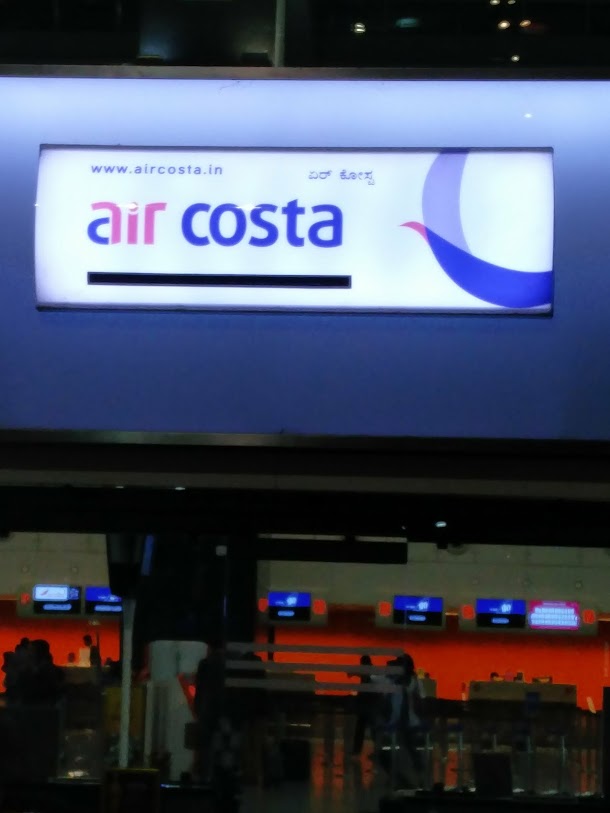
                              Followed by Air Costa

Then the newcomer TruJet.

              Lastly to Vistara another small domestic airline.

Those are the 8 domestic airline counters that I visited.

Then I went to a few international airline counters, starting with the popular German airline Lufthansa.


                     Then Air Arabia.. from West Asia.

                                           Later Air France / KLM from Europe.
There might be more international counters, but I was tired and wanted to just get home.

And finally, our dearest "India's National Carrier" Air India's counter.

Now... Did you observe carefully the 12 pictures posted above?

1) ALL the 12 display boards at airport counters of these airlines, had English prominently displayed. That's because English is the language of business in Bengaluru for white collar crowd, and no one doubts it.

2) Eleven out of the 12 display boards had a small Kannada writing. Kannada is the state official language where this airport is situated, and all the businesses respect the state language by putting a small mention of their name in Kannada. Those who can't read English, will use this. Though for most part it is ornamental in small font as most get their business done with English writing only.

3) Only ONE airline put Hindi in the display. That too with equal size font as English, and positioned above English. Also, this was the ONLY airline which did not put Kannada on the main counter display. And most importantly, this was the ONLY airline whose staff is paid salary using the tax money generated from Karnataka.

I wonder....
  • It is not about for one language or against one language. But how come 11 airlines, including the French, Arabian and German ones understand the basic business etiquette of Bengaluru, but India's "national carrier" does not? 
  • Don't the Air India staff who work at the airport see other boards right next to them daily, and ask themselves.. how come we are ignoring Kannada and putting Hindi on the board, while none of the other airlines, including those from France, Germany or Arabia are doing it?
  • If Air India has to put Hindi display, let them put it. I don't think most people will have any issue with it. If you observed, Air Arabia from UAE is putting Arabic display in Karnataka and no one has issue with it. But Air Arabia is also having common sense to put a prominent Kannada display on the same board!

This is a classic example where business is NOT the primary purpose, but promotion and demotion of languages is... Very disappointed with this irresponsible attitude of Air India and more so because my tax money is paying such people's salary :(

Monday, September 19, 2016

If India has to hit terror factories in Pakistan, be ready for a war with China!

It is about 32 hours since the attack on Uri army camp in India, by Pakistani terrorists. There is tremendous amount of anger in India, specifically in the sections of society which I normally don't see overreact on social media.

This was the front page of paper at my home - "We have had enough!"
Front page of New Indian Xpress, the day after Uri Attack

The overwhelming majority are screaming - Dear Prime Minister.. do something. do quickly..

  • That "do" can be full fledged war. 
  • It can be economic blockade.
  • It can be water stoppage for Sindhu and five rivers of Punjab going into Pakistan.
  • It can be surgical strikes inside Pakistan like India did inside Myanmar last year.
  • It can be as many as there are opinions on social media, papers and TV.

But the big question is.. Can India attack Pakistan this week?
  1. I am sure there is military will power. 
  2. I am sure there would be enough political will power. 
  3. I am sure India has plenty of financial cushion to do this. (Pakistan's GDP is smaller than just one state's in India - Maharashtra)
  4. I am sure internally there won't be much opposition to India for a small scale surgical strike. 

But still.. 69 years of handling of Jammu and Kashmir by India is something we have to look at right now. Can India afford to hit Pakistan where it hurts the most, for Pakistan's obsession with Jihadi terror export all these decades?

While I was looking for some pragmatic answers, amidst very loud war cries that I see in press, TV and social media, I happened to see this tweet set. A very thoughtful set of tweets by the user @vadakkus. From here onward, I am merely reproducing the fantastic probing analysis done by @vadakkus, with very little info from my side. Read it fully and then comment on what Indian government can do, should do, and most importantly, when to do. Vadakkus starts off a tweet storm on the entire Pakistan - India fiasco. There is more than what meets the eye here. And issue is NOT Kashmir. It also does not look like anything to do with Islam, Separatism, Human Rights, Army, AFSPA, Track 2 negotiation and many other things we hear on TV.

It is must deeper than that.. Geo politics!


Why is Pakistan obsessed with Kashmir? I have always wondered what makes Kashmir so attractive to Pakistan, that they are willing to keep the issue burning forever. What IS there?
{Prem Shekhar, a well known Kannada columnist informed a few weeks that Pakistan  had even offered to give up East Pakistan in 1950s, in return for Jammu and Kashmir on the sidelines of official discussions with India! So definitely it is not religion or Kashmiris.. it is much deeper than that. It was water sources then, but now much more deeper...}

Why is India so reluctant to hit back at Pakistan? Also why does India always seem to be unable to retaliate to Pakistan in kind (it should, totally) and pussyfoots around Pakistan, despite all the atrocities it commits in India from daily incursions in Kashmir to the Mumbai attacks. They spend too much money on all this and the country, despite no visible revenue-generating industry (terrorism no revenue) has managed to survive until today, develop nukes and has so much international clout? Where does it get its money from? Why?? Why is India reluctant to strike? There must be reasons.

Yes, water is an issue. The Indus and its tributaries. But where do they get money to keep the issue alive? There is more to this than water. Today, someone told me about this thing and I was stumped about how bloody obvious this is, and even then, NOBODY in India talks about this!

It is China... stupid.. It is China and CPEC: The "thing" is the CPEC: China-Pakistan Economic Corridor. If you look at it closely suddenly everything falls into place. Kashmir, Balochistan, India's unwillingness to strike, silence of international community, everything else. Pakistan is just a front.  

The real sponsor is hiding behind.

Maybe it is because Indian method of viewing everything in black & white. Pakistan sponsors terrorism to get Kashmir. It is not that simple. Pakistan kept the Kashmir flame burning until the 1990s to meet their ends, when China conceived the CPEC and decided to take over. A bit on the CPEC as no one seems to have heard about it. China has a huge geographic handicap: no access to southern world oceans.

So Chinese shipments from Europe, Middle East, Africa have to travel all the way around India, Malacca and ASEAN. China has serious problems with most countries in that region due to its aggressive military posture.

CPEC Need. Source - Twitter. Please excuse since J&K map is not as per India's standards.
Why Pakistan is so important for Chinese economy? What if China could get a route through Pakistan to access the Arabian Sea? That line in blue. Look at it, so much distance, money saved! That, is the CPEC. A corridor of highways and railways will run from Kashgar in China to Gwadar in Pakistan (Baluchistan) on the Arabian sea near Iran border. And ALL the infrastructure and associated stuff for CPEC will be constructed for Pakistan by China, free or cost or for negligible loans.

What is CPEC?Four Six-lane Expressways from north to south Pakistan, four different routes. All main railway lines being upgraded to 160 kph double. A six to eight lane super expressway Karachi to Gwadar and Hyderabad Innumerable coal, thermal, solar and hydro power plants all across Pakistan. All of Gwadar, including a mega international airport! Then Hospitals, schools, colleges, tech institutes, even a Metro line in Lahore!

And of course, the capstone: reconstruction of the Karakoram highway to six to four lanes. All projects listed here. Click, zoom and read.
CPEC Map. Source Twitter. Please excuse since J&K map is not as per India's standards.
But why is Jammu and Kashmir involved here?  Now, on the Karakoram highway, this is where it matters most for India. It connects China and Pakistan, though India! Through Jammu and Kashmir, which legally acceded to India in 1947 October.  This is a route map of the Karakoram highway (grey). Look at the top, inside the red circle. It is Gilgit Baltistan area of Jammu and Kashmir state, which legally belongs to India, but illegally occupied by Pakistan. Keep in mind, China also occupies illegally the eastern and northern part of Jammu and Kashmir - Shaksgam valley (gifted by Pakistan in 1960s) and Aksai Chin (occupied by China in 1950s when it annexed Tibet).

Karakoram highway location. Map from Wiki. Not per India's J&K map standards.
The highway passes through Gilgit-Baltistan, Pakistan Occupied Kashmir. The red line is the LOC. Pakistan and China are connected through Pakistan Occupied Kashmir (PoK for short). Pakistan calls this Gilgit-Baltistan area of Jammu and Kashmir, as Northern Territories sometimes. 

More on Karakoram highway: Soon to be a 4/6 lane highway through some of the world's toughest terrain. A high-capacity highway across the Himalayas!

Now, though the CPEC is a recent thing, the idea had taken birth long back. The Karakoram highway started building in 1959, opened in 1979! Possibly Pakistan had refused China access to Gwadar then as they could. But now they have no other choice but hand over to China.

Why CPEC? OIL: Gwadar is just 400 km away from Muscat and 500 from the Strait of Hormuz through which all Gulf oil passes. 12 hours at sea! Proximity to Africa: China virtually owns much of Africa today. Billions in investment, buys natural resources. Nothing better than this. Pakistan as a market: China will flood Pakistan and Gulf with its cheap products and make a windfall there too. Proximity to new friend Sri Lanka.If USA/UK (control Malacca strait - Singapore) or India in Indian ocean decide to choke it, China will have no problem as it has CPEC. 

But, all of CPEC and China's ambitions bearing fruit depends on the Karakoram highway. That depends on PoK continued to be occupied by Pakistan. 

Money Involved: With the CPEC, China has sunk close to 50 BILLION Dollars in Pakistan. Of course, China gets free access to all this infrastructure in Pakistan. With this, 20% of Pakistan's GDP is now Chinese. China has Pakistan now firmly by the b***s, so much so that Pakistan can now be China's 24th province. With so much invested and at stake, China wouldn't even think twice about ruthlessly suppressing any attack on Pakistan, because they own it now. 

Doesn't India know all this? Of course India knows all this. If we were to attack Pakistan, we would have to deal with China. Pakistan is small fry. China is not. 

Who would side with India? Mostly nobody. Why? Because China is involved. How international geopolitics work, most don't get that either. USA wants to support us because China makes it nervous. But US corporations are over invested in China, so Uncle Sam will look the other way. Russia - Don't even think about it. Putin has enough troubles at home, and India's pandering to Obama hasn't got him amused. Europe will sit just and watch (because China), and all of the Middle East will (clandestinely) support Pakistan for obvious reasons (Islam).

People think alliances between countries are forget like high school friendships - on emotional grounds of some sort - No. Not at all. International friendships are always based on "how can I benefit by allying", "what terrible can this guy do to me if I don't ally".

So, India will left out cold if it were to as much as touch Pakistan. We will mostly have to take on BOTH Pakistan and China. Mostly. Can India take on both Pakistan and China alone? From two (or three) flanks? We are surrounded by China's friends. What do we do? Dunno.

A bit more on the Karakoram highway: 1962, remember? What if the Chinese were testing the Indian waters before building the highway? China could've walked through India. Still, they withdrew. They were only testing India's resolve to defend PoK if it came to that. We have all but written off PoK. All Wikipedia articles tell all of PoK as "Pakistan". Not Pakistan administered", but Pakistan. Hurts :(

Here is the Khunjerab Pass (PoK): the "top" of India, the border between India and China, but now Pakistan. 

A sign in Pakistan Occupied Kashmir - Source Twitter
Here is the Karakoram highway near Gilgit in India (PoK) and under construction somewhere in the mountains. It should be obvious by now that China does NOT want India to reclaim its land lost to Pakistan in 1947 and 1948 - the strategic Karakoram ranges in Gilgit-Baltistan area of Jammu and Kashmir. It is as simply as that!
Karakoram Highway in PoK part of Jammu and Kashmir state. Pics - Twitter

Here is the entire map of the Karakoram Highway from Kashgar to Rawalpindi. Look where all it passes through. 
Karakoram highway map. Source - Twitter
China owns Pakistan for most part today: CPEC and all associated stuff are called "China-Pakistan Friendship" something or the other. No friendship there. Just Chinese business. China is not doing business with Pakistan. It is running its business in Pakistan. It is running Pakistan. China pays for protection. If things get push to shove, China can tell US: "We will nationalize your businesses if you don't tell India to withdraw". What will we do? 

What we should first realize is that there is no Pakistan. There is only China. Pakistan is just a front. We should deal accordingly. It is in China's interest to keep Kashmir burning. If there is peace in the valley, India MIGHT set its eyes on PoK. Chinese know that India has a strong Prime Minister today who can think of that. China does not want India to even think of getting PoK back. Of course, China did not light the Kashmir fire, but it certainly looks like it is them who keeps it burning that no consensus is reached. So, in addition to water, religion, ego, demographics and so on there is one more reason behind the Kashmir unrest: China and CPEC. 

Is dialogue with Pakistan sensible? It is utter foolishness to think that in such a case we can resolve this through dialogue! We talk one thing while issue is another! Issue is NOT what we think is the issue! We and our govt should first understand this. I am sure they have. Hopefully they aren't helpless. China is waging a proxy-proxy-deceptive war which we cannot understand or prove or blame. We need to mobilize some other way.

War with Pakistan? Vadakkus said at the end - I am not generally not a warmonger, but this has gone too far. We should strike. Do something. I only wish something be done about those 17 Indian soldiers who were killed without any provocation. They didn't have to die. Take on both China and Pakistan. Maybe. Can we? I don't know what we should do. Hopefully our hands aren't tied and someone is coming up with a plan to hit them. Hopefully. 

Baluchistan's role: Why Pakistan got all worked up when India raised Balochistan? Gwadar is in Balochistan. Much of CPEC infra passes through Balochistan. The CPEC is China's hope at lifting its sagging economy and securing its strategic position in the region. Its future maybe depends on it. Karakoram- Hindukush- Pamir region since ancient times been strategically sensitive. The Silk Road. China wants control of the new Silk Road. If India were to take PoK we would squeeze the Karakoram Highway shut. No more CPEC, Silk Road. China done for. That is the whole game. Highways are primary military conduits rather than civilian. Whoever controls the highway controls the region. 

Ultimately.. Pakistan's ultimate aim is to establish an Islamic caliphate. Apart from this China helps them through CPEC.  You might disagree with Modi et al but please support the govt right now in whatever action it takes. Politicking can wait. Wait two more months before taking any harsh decisions. Things might change post November.

What do you think India should do now, after reading this fully?

Wednesday, September 14, 2016

Kaveri: Current Situation in Karnataka's Dams

Background: It is the second week of September 2016. A very bad week in south India. Lot of disturbance, violence, animosity etc. It is that season of the year where Supreme Court gets involved and Kaveri is a big topic. This year, it went way worse than the previous few years due to many reasons. 
  1. In 2012, I had written a comprehensive writeup on what is the Kaveri issue, what are the issues from Karnataka's side, what are the issues from Tamil Nadu's side, and how this can be solved in the long run - Kaveri River Water Sharing : What Are The Solutions? I had listed 10 solutions, based on what I read from experts. Now more solutions have come up too, like desalination. 
  2. In 2016, The same has been used in this better articulated Quora answer. - How can the Cauvery (Kaveri) river issue be solved?

For those who want long term solutions, and points of view from both states, please spend time in those links, and also check out references from each. You will learn a lot about actionable steps!

This analysis is Not for YOU: And those who are busy distributing violence videos, sarcastic or insulting memes, chest beating that Kaveri is only "ours", please continue doing that. Don't read this any further. Because my intention is not to discuss any point that is fruitless when it comes to final water sharing details. I am more focused on actual figures, statistics and actionable steps.

What is the water situation in Karnataka in September 2016? Now the rest of this writeup would be purely showing the water situation in Karnataka's Kaveri basin as of September 13th, 2016. This is fully using a fantastic analysis done by a Twitter user named V Vinay - @ainvvy . He calls himself a curious academic entrepreneur. Again, all the information provided from this point on wards, is only from Karnataka's dams, as I did not see any qualitative analysis or data from Tamil Nadu's dams. If you know, please share in the comments and I will update here.

Names of Dams: Mr. Vinay managed to download the daily inflow and reservoir levels at the 4 Karnataka dams: Harangi, Hemavati, KRS, and Kabini.

Water Measurements: Before getting into the data, we need to understand TMC and cusecs. For historical reasons, the measurement is in terms of cubic feet. 1 cubic feet is roughly 28.3 litres of water. cusec stands for cubic feet/second. Or as @sheksis joked, 28 Bisleri bottles/second... More relatable :)

What did Supreme Court say on 12th September 2016 in the modified order? 
The current SC order for example asks Karnataka (KA) to release 12,000 cubic feet of water every second. TMC is a thousand million cubic feet, which is a billion cubic feet of water. This is 1,000,000,000 = 109 = 1 billion cubic feet. Also, important to note that this has NO component of time involved here. It is just a measure of water. 

So if 10,000 cusecs of water is released for a day, it amounts to 0.86 TMC of water. 15K cusecs amounts to 1.3 TMC a day.

In Human usage terms: To get a sense for these numbers, how much of water is used for drinking, washing cloths, bathing etc. In other words how much water is needed for human in Indian terms, per day? It is usually taken to be about 100 Litres per person per day. This translates to a little over 3.5 cubic feet of water. Do not compare with other countries where more water is available per capita. @abhicrux said, 135 liters/person/day is used for standard hydraulic calculations. All uses included. Rural south India gets less than 100 liters today. So we will go with 100 liters on the average side per person, in a water starved south India. 

Drinking Water Needs of Karnataka's Kaveri basin: The estimated number of people in Bengaluru, Mysuru, Mandya and other Kaveri basin areas is about 1.6 to 1.8 crores. This amounts to about 0.063 TMC of water a day. Let's call it drinking water, even though it is for other daily use purposes too. Essentially anything that is not related to irrigation which is the primary user of Kaveri water. Note that not all parts of Bengaluru get Kaveri water. This computation is only for the areas getting Kaveri today.


Taken over a year, it amounts to about 24 TMC of water. This is the water that the state needs to have to take care of drinking water needs. Of course, there will be losses of all sorts, so the figure is likely to be more like 35-40 TMC. Losses are usually in the form of evaporation loss, distribution loss and leakage from dams and pipes.

Water in Dams of Karnataka: Now let us get back to the 4 dams. Harangi has a storage capacity of 8 TMC, KRS in Mandya district has 45 TMC. This is the biggest and the most important reservoir in south Karnataka. Hemavati has 35 and Kabini has 16. That totals to about 104 TMC that can be stored MAX by Karnataka at any given point of time. With around 750 TMC of water estimated for Kaveri river as a whole in a good monsoon year, this is about 14% of Kaveri water that can be stored by Karnataka, at any point in dams.

This is the capacity. Current levels as of September 13th 2016 are at about 5 in Harangi and about 10 in the remaining three. They add up to 35 TMC in total across ALL dams in Karnataka on Kaveri basin. All these are computed with live storage of water without getting into dead storage analysis (which amounts to water that can't be released from dam at the bottom). An additional discharge at the current levels of 12000 cusecs to TN over the next 8 days will mean 8.3 TMC of water. Since some of the water will surely be released for other purposes, and with some inflow, the likely level in 8 days is 25 TMC. Again 25 TMC in total across ALL dams in Karnataka on Kaveri basin. This 25TMC is what we will have to survive with until June-July of 2017 when you will see south west monsoon filling in dams again. That is at least 9 full months with 25 TMC of water, if no further rains happen :(

What about farmers in Karnataka? Forget irrigation using above mentioned water levels. Farmers are screwed in Karnataka for this year! You need 100 to 150 TMC of water for irrigation for rest of the year in Karnataka. Not sure if they could even get one full crop this year, while Tamil Nadu is planning for the second crop now, and might get a third crop also early next year. This is the fundamental reason why Karnataka was burning for days in September 2016.

Dynamics of Dams and Inflow Analysis: Let’s look at the dynamics of the dams. Vinay's data starts from 2011. So we have about 5.5 years of data. Here is a table of the total inflow into various dams. Kabini has small capacity but matches Hemavati in inflow.
As you can see, Harangi and Hemavati sit behind KRS, while Kabini is ‘independent’ and joins later.


Keep in mind that some outflow from Hemavati can be inflow to KRS, etc. Vinay focuses on KRS and Kabini to look at the data more closely.

Here is Kabini. Most of the water in the months of June to September.
And then the inflow dies down. Look at September. This time we are done through about 10 days. And the inflow has been a mere 1.5 TMC!
Likewise, KRS dam near Mysuru, has got an inflow of 3.3 TMC for the first 10 days of this month. Will it hit 10 for the month?

Then Vinay plotted the reservoir level and inflow for KRS. This graph is revealing. Notice how the reservoir level shoot up at monsoon (where the inflow is heavy) and how it progressively decreases until the next. There are small inflows in between, but noting compared to what happens during the monsoon.
And notice the 2016 inflows and reservoir levels. It is quite pathetic. So the usual inflow after monsoon will also be limited this year. Usually, post September of any year, the inflows are about 25-30 TMC. We don’t see it happening this time. But we don’t have enough data to predict.

What's for Karnataka for rest of 2016 and first half of 2017? It is going to be a very tough year at this side of Karnataka. Farmers are already ditched for 2016. Drinking water might be barely sustained at the current storage levels, for the next 9 months. See above graphs and inflow analysis.

Vinay says that Tamil Nadu gets two monsoons and has better groundwater than Karnataka. Some people are disputing this two monsoon theory, but what Vinay means is that Tamil Nadu gets both South West and North East monsoons. Remember Chennai floods in 2015? That was the North East Monsoon season.

After reading this analysis, it became very clear why Karnataka farmers and Kaveri delta drinking water users, are absolutely outraged at the current situation of draining the remaining precious water from dams. Every TV channel in Karnataka is saying the same thing - We have no drinking water.. why are we being forced to leave the remaining water for growing 2nd crop in Tamil Nadu? Drinking water takes precedence over everything else when it comes to human needs. 

Any Suggestion for Politicians of TN and KA? The two states need to demonstrate better sense than landing in court every time there is a distress. Lack of sagacity is the problem. For those who say the Supreme Court would have ‘looked’ at the data and come to the conclusion, Vinay says, he does not know. These graphs don’t seem to suggest so…

There is more in the data, but Vinay says that he will take it up on some other day.  Vinay got all these data using a simple python program… shouldn’t take more than 20 minutes for a programmer to write.

Let's stop here, hoping wisdom prevails all around. I don't think a blog or set of tweets can change politics, courts or tribunal happenings, but this is only meant for common people like you and me, to understand the dire situation in Karnataka today.

Source of Data for Karnataka's dams and water levels: https://www.ksndmc.org/Reservoir_Details.aspx

I wish I could find similar data on Tamil Nadu's dams starting with Mettur for September 2016, to see how good or bad the situation is for Tamil Nadu farmers. Again, if you have similar data from TN, please do share.

Thanks again, Mr. Vinay for a classic analysis.

Sunday, August 28, 2016

Meet Captain Naveen Nagappa - Kargil War Fighter

Jammu and Kashmir is again in news.

50 days of curfew, non stop media coverage, 10s of crores of Rupees coming from Pakistan to sponsor stone pelting, anti India slogans in the so called "human rights" events, with natural reaction against anti nationals from Desha Bhakta students on streets, and much more. So I attended the well publicized and very well attended Nilume event today in Bengaluru. This Nilume group is the most active group of Kannada bloggers today with 1000s of highly creative writers. I went there to understand the situation from three different angles:-
  1. One from police angle narrated by the former Commissioner of Police of Bengaluru city, Mr. Shankar Bidari
  2. Second from a researcher, professor and journalist angle narrated by the popular Kannada writer Mr. Prem Shekhar. He has also written books on Jammu and Kashmir.
  3. Third from a Kargil war veteran, Captain Naveen Nagappa, who fought valiantly to protect India's sovereignty in the Himalayan hills in July 1999.
I was thoroughly impressed with Mr. Bidari and Mr. Prem Shekhar's narrations. They covered the issue from human rights, army morale, history, blunders of Nehru, British and US bias, geo-politics and war perspective. They were outstanding. Between them, they spoke for over 2 hours, so I will try to narrate their talk a little later on Facebook and Twitter. I knew both of them and admired them for years. Awesome gentlemen!


Here, I want to jump straight to Captain Naveen Nagappa. Honestly, I did not know about him till date. Shame on me! I did not know about a valiant Indian army man who not only fought bravely at Kargil protecting us, but also survived a serious injury to tell us the story. But it is never too late. So you can learn more about him here..

It was January 1999. A young Engineer from Karnataka called Naveen had joined Indian Army, instead of going to do Masters Degree in Engineering. He had great dreams of protecting our Bharat and had become a part of 13th Jammu and Kashmir Rifles group. This was the group of Late Captain Vikram Batra, of "Yeh dil maange more" fame. This battalion got numerous awards during the war for supreme sacrifice. Our of the 4 Param Vir Chakras awarded during Kargil war, two were given to his JK Rifles unit.

While he was just getting started with his army career, General Musharraf and Pakistanis were planning and executing something sinister. They were breaking the Gentleman's agreement between India and Pakistan of vacating the 16000 feet plus altitude hills during extremely bitter winter periods. They were not only occupying the Kargil heights, but also were building bunkers and getting ready to shell Indian army's vital Siachen and Leh supply routes from Srinagar in Jammu and Kashmir state.

Things came out open in May 1999. But June Indian army was fighting to capture the hills back, one by one. When Naveen's team was sent in early July to capture a vital hill, he was put in reserve.
Point 5140 was where the big battle was starting. Captain Batra and team had already fought there, but Naveen was not given a chance to fight. His team was sending radio signal, including "Yeh dil maange more" kind of awesome slogans. But Naveen was not fighting in the open. He desperately wanted to.
 When his team was given a big task for 3rd and 4th July 1999, he went and pleaded his chiefs like General Yogesh Kumar Joshi. Naveen pleaded that he did not leave his chance for Masters in Engineering, and come all the way to Jammu and Kashmir borderline, to just stay in the reserve. He wanted to fight. His boss asked - You are here only for 6 months in the army. Not only your safety, but also the safety of 120 people who are with you matters, with your split decision. It is not easy. But Naveen did not quit. He kept on requesting and finally got the stamp of approval to lead a mission.

Super excited, Naveen was on the mission to liberate "Point 4875" near Kargil. Captain Batra had told Captain Nagappa one simple thing - "Naveen, you take care of your men, and they will take care of you". So Naveen started his expedition with JK Rifles' war cry - "Durga Mata Ki Jai"!
Location of Point 4875. Source: http://lazydesiauthor.com
We have heard more of Tiger Hill and other popular named hills. But a few of these numbered hills were vital to get to the top of Kargil mountains where Pakistanis had setup bunkers, so that they can be kicked out of Indian side of Jammu and Kashmir. So the battle started on 4th July 1999. Incidentally the day of Vivekananda and US independence too! Personally, I had just crossed oceans at 38,000 ft to get back to India that morning, but had no clue that supreme sacrifices were being made exactly at that time by the brave jawans of India.

Naveen and team had followed the same buddy system that army follows. Everyone who goes out in the night for attack, is paired with another brave soldier. Their job is to make sure that if something happens to one, the other would take care of it. Naveen had just seen his buddy suffer badly the previous night. But there was no going back. He had to fight on 4th morning, 4th night, 5th morning, 5th night, 6th morning, 6th night... They had to melt water from snow capped mountain for drink and eat some energy food carried with them. They could not move easily as the enemy was in higher location and had clear sight of them. But their mental power carried them. Why? They had heard about how Pakistanis had tortured Late Captain Saurabh Kalia and team who had gone on a fact finding mission earlier. They had heard about the gory details of brutally Pakistanis had taken out organ by organ of the brave Indian soldiers who were taken as Prisoners of War. They had heard about how after torturing in the most inhuman ways, Pakistanis had shot Kalia and team at point blank, before "returning" the bodies to India. When you hear such barbarism and brutality of your enemy at front lines, you just get the energy to hit back. No question of fear or family or tiredness. That was Captain Nagappa and team during those extremely difficult moments of July 1999.

They kept fighting bravely. And then a grenade landed in front of Naveen. He was trained on how to handle a grenade when it lands. Usually you have 6 to 10 seconds. A grenade can kill everyone within 10 meters radius. So the first instinct of Naveen on 7th July morning was to just pick it up and throw it away. But a body that has been fighting non stop for 100+ hours can't really throw a grenade back 100s of feet as they show in movies. Unfortunately, the grenade came back after hitting a boulder.. Now Naveen had 2 to 3 seconds!!

His thought was - Anyway the explosion will happen now. I have no chance of escaping. At least, let my upper body go back home in one piece, rather than piece by piece in a bag. So he hid his upper body from grenade and exposed only his lower body. Booooom.. the explosion happened and before he knew what happened, he was in severe pain. His legs were hit. But in a conflict zone, you can't just get away after being injured. Any movement will attract more bullets. So he controlled his extreme pain of both legs being damaged and still fought on. But his team observed and asked him that he should crawl from the mountain to the bottom slowly. He did not agree, but they convinced him that he had to do it as he was seriously injured. With great reluctance, Naveen left his team to fight further, and crawled back to the lower heights very slowly. As you can imagine, he would be in tremendous pain and losing blood rapidly. Still he made to the bottom. The first thing he did there was to remove his snow shoes which are below the knee, but above the ankle. And then he realized how hard he was hit as his blood turned a few feet of snow around him red! He had literally spilled half of his body's blood for Bharat Mata, in an un-named hill, 1000s of KM from his home.. what a spirit! Still he wanted to fight barely having consciousness.

Even there, you can't expect a quick evacuation as the enemy was a higher position, observing everything. So it took lot of time. Finally after hours, he was given basic treatment and taken to the nearest helicopter. With great reluctance, he had to head away from the fighting zone, in the army helicopter taking him to Srinagar. And when the chopper took off, at a lower height to avoid firing from higher hills, he was losing consciousness due to heavy blood loss. Just then his chopper flew past Point 4875 for which he almost sacrificed his life. And there the Indian national flag, the tricolour was flying proudly!! After watching it from the army chopper, under lot of sedatives to kill the pain, he finally closed his eyes in total satisfaction. YES!! My boys have done what I went there to do......... What a relief!
His mind was -

"Naveen.. You have left a legacy behind.. whatever happens after this is irrelevant. Whatever role you were meant to play, you have played. You have created history".

Then he spent 21 months in the hospital undergoing treatment. He had to undergo 8 surgeries. He got the Sena Medal. His spirit kept him going even when the bravest of human minds crumble when hospitalized for such a long time.

And he narrates one other thing from his hospital stay. The mother of his close friend from army came from Dilli to visit him. She had lost her son during the same battle. Naveen could not sleep the prior night as he did not know what to tell that Maa, about her son. He could not digest that fact that he was alive, but his close friend soldier had made the supreme sacrifice for India. She came and met him. He talked with his "aunty" with lot of respect. They talked for 2 hours, but she never asked about her son not returning. Naveen could not take it anymore when she was about to walk away. He asked her.. "Aunty.. I am extremely sorry that I could not get your son back, while I survived myself". She told in a calm way - "Naveen.. it is the best honour for a mother to see her son wrapped in a tiranga. I am proud of my son". No need to highlight that when Naveen narrated this today, he got loud claps from the emotional audience in Bengaluru.

Why am I writing all these 17 years later? Because when I was busy building my high paying corporate career in 1999, these young men, some younger than me, were busy shedding their precious blood drops for Bharat Mata. As I am typing this, I am sure 1000s are taking extreme risks in the Himalayan mountains, rough seas, dangerous central Indian jungles and much more. During every real estate purchase we do, ever mall purchase we do, every road trip we take, every party we enjoy, every cricket match we cheer for, every political rally we attend, every TV show we watch, every birthday party of kid we celebrate.... there is an Indian army soldier making a split second decision whether to sacrifice his upper body or lower body because that grenade is about to explode. Either he is facing the situation in real, or training hard in drills. Sooner or later that situation would come for many brave fighters as we are surrounded by internal and external enemies.

Hold these brave soldiers with the highest respect. We have NO IDEA of what they go through.. when you can't even take out your shoe for hours to check if your bleeding legs are still attacked to the knees or not, THAT is sacrifice for mother India. That is what 1000s of these Jawans are paying with their blood for our safety each year.

Oh.. did I tell you that all the tall promises politicians made to him - nothing has materialized till date :( You can hear his narration here, from an earlier event.


You can read about another narration of meeting with Captain Nagappa here. They have posted one memorable picture from Kargil times.


The next time you hear some nincompoop talk of "human rights" or "azaadi" slogans against these brave Jawans, just ask them to go speak to brave sons of Bharat Mata like Captain Naveen Nagappa in Bengaluru. I can take them personally.


Freedom is not free. It takes a lot of blood, sweat and tears to protect it. DAILY!